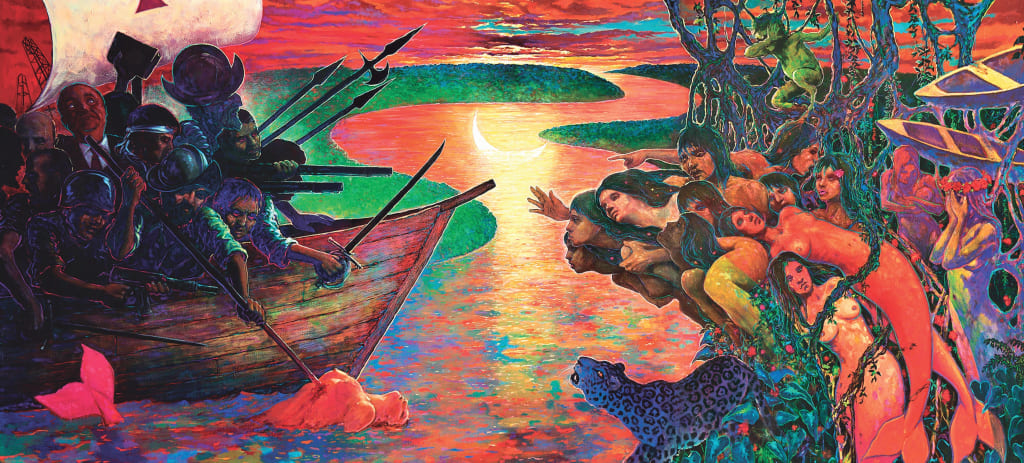
Gino Ceccarelli, “El Desubrimiento del Amazonas”, The appropriation of America was not merely the encounter of two cultures, but also the collision of two fundamentally different ways of understanding the world.
The Expansion of Being, Part II:
Europe 1492
Around 1450, Europe was a fragmented continent, caught between medieval stability and the turbulence of a new era. Scarred by plague, war, and simmering unrest, its people lived as their ancestors had lived for centuries. Some sixty percent were peasants and serfs who worked the land for the nobility and the Church.
Their lives were short and hard. Disease carried off a third of all children, and few people lived beyond forty-five. They slept in smoke-filled huts, owned little more than two sets of clothes, and rarely left the place where they were born.
The world was small and had narrow boundaries, not only on the map, but also in the mind.
The Church held absolute authority. It determined what was true and what was not. It explained nature, disease, and misfortune. Hail was seen as God’s punishment. A deformed birth was read as the work of the devil.
To doubt was to risk not only one’s life, but eternal damnation. The Bible was almost the only book, Latin the language of the educated, and the priest the window to the world. Alexander VI, the Spaniard Rodrigo Borgia, was Pope. Ecclesiastical corruption was visible to all, and the trade in indulgences flourished.
Fear of God and Curiosity
But beneath the surface, something was already stirring. In Italy, the Renaissance was in full bloom. The ancient world was being rediscovered, the individual celebrated, and the beauty of the world embraced. The printing press, developed around 1450, began spreading knowledge on a scale previously unknown. Humanists studied Greek and Roman texts, cartographers drew new maps, and princely courts patronized scholars, artists, and navigators.
It was a time of transition. Medieval structures still held, and princes sought new sources of revenue to finance wars and courts. The thinking of the elites remained deeply religious: history appeared to them as part of a divine plan. While the old feudal order still maintained its bonds with nature and the cosmos, a new epoch was already taking shape on the horizon.
Since the late Middle Ages, Europe had been fascinated by the legendary riches of India and China: spices, silk, gold, and precious stones. The longing for the East grew, and with it the desire for the treasures Marco Polo had described. City-states such as Florence, Milan, and Genoa flourished culturally and economically.
The Hanseatic League, with Lübeck, Bruges, and Hamburg, dominated trade across the North and Baltic Seas. Venice controlled Mediterranean commerce in goods from Africa and Asia. The florin and the Venetian ducat were Europe’s first hard currencies.
A Continent of Trade
After the Ottoman conquest of Constantinople in 1453, the Ottomans controlled the traditional overland routes to Asia — the Silk Road and the Spice Road. They levied tolls and decided who could pass. For many European merchants, trade became dependent on intermediaries, and therefore more expensive, slower, and riskier. This situation made the idea of finding a westward sea route across the Atlantic increasingly attractive, as a way to reach India and the Spice Islands directly.
The Portuguese had been exploring the African coast since 1440, in search of gold, ivory, and slaves. They established an extensive trading network. Along the African coast they built trading posts such as Arguim (1443) and Elmina (1482), from which they acquired captive people. The largest numbers were sent directly to Lisbon, Seville, and Cádiz, where they worked as domestic servants, craftsmen, dock workers, and carriers. By the early sixteenth century, up to ten percent of Lisbon’s population was of African origin. On the islands colonized by Portugal — such as Madeira (from around 1455), the Cape Verde Islands, and São Tomé — a new and brutal economic model emerged: the sugar plantation worked by enslaved people.
They also sought a passage to India. Bartolomeu Dias proved in 1488 that Africa had a southern tip and rounded the cape, but exhaustion and lack of supplies forced him to turn back. He did not reach India, but he proved that a sea route existed.
The threat was clear. Queen Isabella of Spain knew that Portugal had almost reached India. If Portugal controlled the East, Castile would have to find the West. Spain felt the pressure of time and dispatched Columbus. He reached America in 1492, believing he had arrived in India. Vasco da Gama sailed around the Cape of Good Hope to Calicut in 1497 and established trade with India in 1498.
The First Voyage of Columbus
Columbus and his ninety men sailed for two months across the ocean. They did not know what lay ahead, had no maps, and were sustained only by the hope of finding a sea route to India. They landed on Guanahani, an island in the Bahamas. In the name of the Spanish Crown they immediately took possession of the island and christened it San Salvador — the island its inhabitants called Guanahani.
Columbus had not set out to discover a new world. He was looking for India, which he believed he knew from the accounts of Marco Polo, and called its inhabitants „Indians.” He died in 1506, convinced that he had found the westward sea route to India, never knowing that he had stumbled upon a continent previously unknown to the European world.
Amerigo Vespucci
It was the Florentine Amerigo Vespucci who, after his voyages along the South American coast around 1500, was the first to recognize that these landmasses must constitute a new continent. The first indication was the Orinoco. He observed that the river was so vast that the land from which it flowed must be an entire continent. A river of that magnitude could not exist in an Asian archipelago.
The second confirmation came from observing the stars. Vespucci was the first European to chart the Southern Cross (Crux), as well as Alpha Centauri and Beta Centauri — two of the brightest stars in the southern sky, belonging to the constellation Centaurus. These constellations are only visible south of the equator and were unknown in Europe. Had this been Asia, Asian or Arab navigators would have documented them long before.
Mundus Novus
He called it „Mundus Novus”, the New World. In his honor, a German cartographer gave the continent the name „America.”
In his letter Mundus Novus (1502/03) to Lorenzo di Pierfrancesco de’ Medici, Vespucci described how he had sailed so far south that the North Star disappeared entirely and the stars of the south took over navigation – things that did not accord with the views of the philosophers and astronomers of his time.
His conclusion was revolutionary: these lands were a New World, for his ancestors had no knowledge of them, and the greater part of this world lay south of the equator. (Mundus Novus, 1503)
The idea of a fourth continent was simply inconceivable to the European mind of the time. The biblical worldview recognized three continents: Europe, Asia, and Africa. That there could exist an enormous landmass between them, inhabited by millions of people not mentioned in Scripture, was a sacrilege against the established worldview.
For many clerics and scholars, this was initially incomprehensible. The Church found itself struggling to provide answer, but its response was not long in coming.
On 3 May 1493, Pope Alexander VI declared the newly discovered territories to be a space that must be integrated into the existing Christian order. From this he derived the right to administer this New World and the obligation to evangelize it. Its division was presented as the extension of an already existing order into a previously unknown space.
For God, Wealth and Glory
One day later, on 4 May 1493, Pope Alexander VI did something with the papal bulls Eximiae devotionis and Inter caetera that sealed the instrumentalization of faith in the service of the power interests of the crowns: he divided the planet between the two rival maritime powers, Spain and Portugal.
The Holy Heist
The Pope drew an imaginary line from pole to pole, approximately one hundred miles west of the Azores. Everything to the west of that line that was not already in the possession of a Christian ruler he „donated” to the Spanish monarchs. Everything to the east, including Africa and what would become Brazil went to Portugal.
The division of a still unexplored continent with the stroke of a pen. What may appear at first glance as an absurd presumption followed the logic of its time. As the vicar of Christ on earth, the Pope considered himself the supreme authority of a universal Christian order. From this position he derived the right to dispose of territories that neither belonged to him nor were known to him.
The bull Inter caetera granted European expansion a religious and legal legitimacy. The appropriation of territories was presented not as conquest, but as the extension of an existing divine order. Whoever took possession of land, resources, and power did not see himself as a robber, but as the rightful administrator of a divine mandate. It was a highly rational calculation — the birth of an alliance between absolute ambition and systematic enrichment, sanctioned by the highest moral authority of the age.
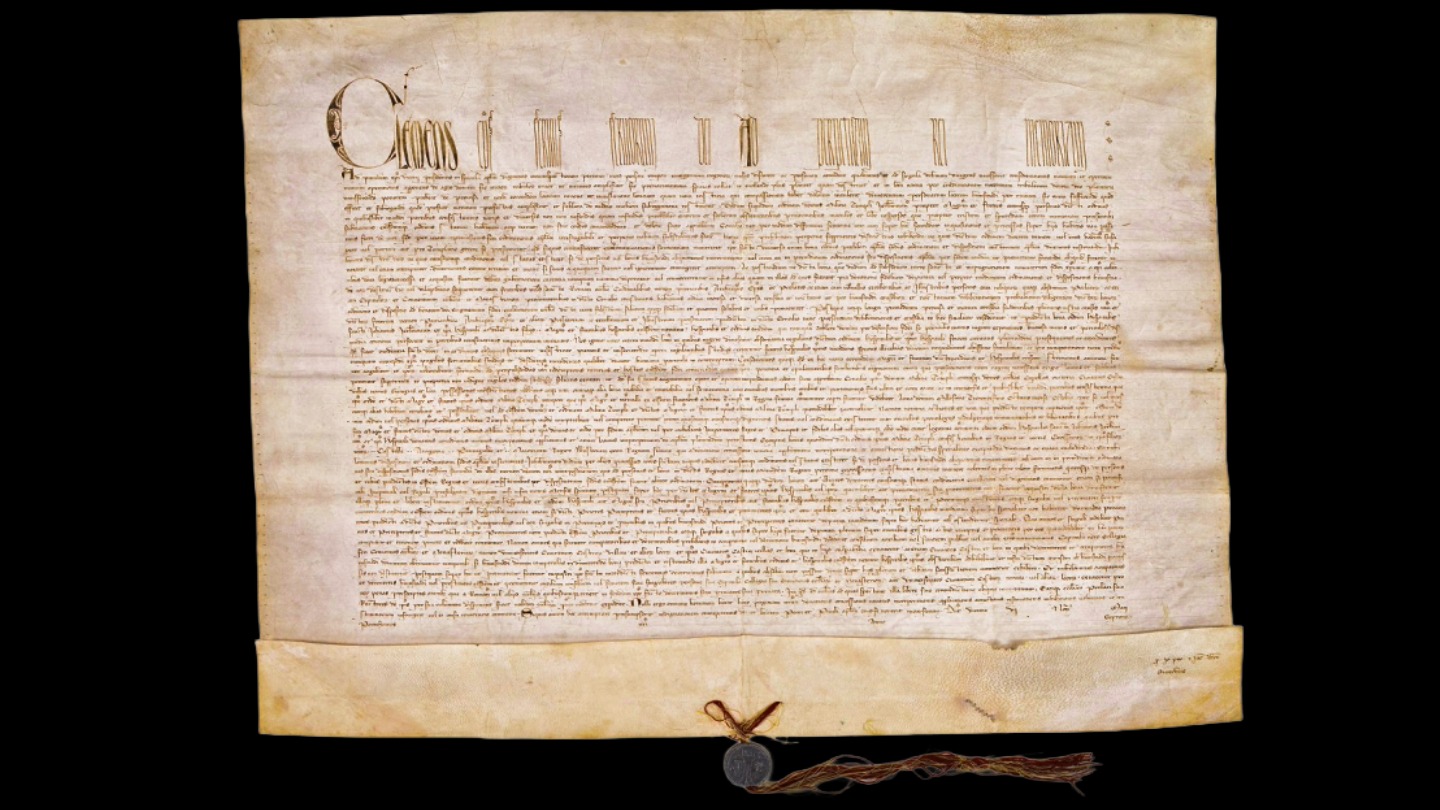
Papal Bull Inter Caetera (1493) The document with which Pope Alexander VI divided the New World between Spain and Portugal is preserved today not in Rome, but in the Archive of Seville. There still rests the parchment bearing the papal lead seal with which authority was claimed over continents its authors had never seen.
In God’s Name
Since the inhabitants of the newly claimed territories were not Christians, they were considered to have no rights under the international law of the time. They were not perceived as fellow human beings or neighbors, but as mere objects of a global administrative act.
Their lands were treated as if they were available and simply waiting to be taken. Yet America was by no means an empty space. Millions of people had lived there for millennia. They inhabited cities, practiced agriculture, maintained trading networks, and possessed political and legal orders. The people whose homeland was being disposed of had no part in that decision.
The donation came with a condition: Spain and Portugal were required to convert the inhabitants to the Catholic faith. The salvation of the souls of the indigenous people became the moral cover for their physical and material exploitation.
They were defined as souls that needed to be saved, but as human beings with no right to property or self-determination. This was the moral license for what followed, in the name of a „higher salvation.” It is the ultimate act of alienation: the separation of people from their land and their rights, of human beings from their homeland, by an abstract line drawn on a map.
The Sealed Fate
The Inter caetera was no mere document. It was a papal bull (bulla papalis), a term derived from the heavy lead seal that hung irrevocably from this decree of absolute power.
In a palace in distant Rome, the fate of millions of people was decided — without consulting them, without granting them any rights whatsoever.
By pressing his seal into the soft lead, the Pope stamped the New World as plunder. The bull transformed injustice and exploitation into a divine mission.
The confidence with which the Pope divided the world between Spain and Portugal with the stroke of a pen is explained by the fact that he still spoke with the undivided authority of the vicar of Christ. There was as yet no Luther, no Zwingli or Calvin, no theological challenge. The arrogance of this administrative act rested on an institutional certainty that would shatter within a few decades.
The gold of the colonies would go on to finance, from the sixteenth century onwards, the conflicts that arose from that fracture. But the foundation of colonization, the Inter caetera was laid at a moment when the Christian world still appeared united under papal leadership. This sacred act of dispossession needed precisely that moment of unbroken authority in order to function as a legal act.
With God’s Blessing: A License to Plunder
The willingness to accept the destruction of entire civilizations in the name of gold and strategic dominance was not collateral damage of expansion, but the consciously calculated price of securing Western supremacy.
It was no accident of history that the road to European modernity passed over destroyed indigenous cultures. The accumulated wealth was not the result of organic progress. The conviction that the rights of the European newcomer fundamentally annulled and rendered void the right to existence of the indigenous inhabitant became the foundation of a new world order.
The Inter caetera was the receipt for a world that had not yet even been fully discovered. It confirms that the alienation from nature and from fellow human beings was not a gradual process, but a deliberately planned system. The legal foundation for a genocide was laid before the conquest began, and it was called „divine order.”
Colonialism did not end when the flags of the invaders were lowered. It survived in the way knowledge is organized, progress measured, and the elevation above nature legitimized. Exposing this deeply rooted way of thinking is one of the main concerns of this essay and serves the recovery of an unobstructed view. It is about recognizing when the same methods are repeated under another name.
Saving Face – De Indis and De iure belli
The news of the existence of lands and peoples previously unknown beyond the Atlantic triggered intense debate among educated theologians and jurists across Europe. Francisco de Vitoria (1483–1546) was a Dominican friar, professor, and one of the central thinkers of the School of Salamanca, the intellectual heart of Spain. His work not only revolutionized theology but also laid the foundations of modern international law.
Confronted with reports of the Conquista, he began to examine the moral and legal questions raised by the discoveries. Vitoria argued that indigenous peoples possessed their own rights and claims to property (dominium) that no one could arbitrarily violate. In his lectures „De Indis” and „De iure belli” (1539) he analyzed the Spanish conquests and criticized them as unjustified in most cases.
Vitoria’s criticism did not come from nowhere. It was the response of a serious thinker to a moral catastrophe unfolding before everyone’s eyes. But criticism and complicity do not always exclude one another.
The Back Door of Pretext
He argued that indigenous peoples were full human beings with rights of property and governance, that Spain had no right to conquest on the grounds of discovery or the claim to conversion alone, and that the Pope held no temporal power over non-Christians. War could only be waged under strict moral conditions. The universal dignity of all human beings had to be recognized.
Francisco de Vitoria was held in high esteem — Emperor Charles V consulted and patronized him. Yet at the same time he opened back doors for the Crown to pursue colonization. He permitted war in defense of the right to free trade, free preaching, and against cannibalism and human sacrifice. In such cases, Spanish interests could be enforced by force if necessary. He wrote: when these rights are denied, „it is legitimate to occupy cities, depose rulers, and take populations prisoner.” (De Indis, Pars III, para. 1–4.)
The universal dignity of all human beings that he proclaimed was therefore only valid insofar as it did not stand in the way of European interests.
The Unmasking of a Way of Thinking
It would be too simplistic to read this history as merely a sequence of crimes committed by individual actors. The point is not to assign moral blame to the past—doing so would change nothing—but to expose a way of thinking that continues to underpin many of today’s global structures.
The Architecture of “Inclusive Exclusion
With Inter caetera, a legal and philosophical mechanism was developed whose effects continue to this day: the invention of the concept of an “incapable humanity.” The “other” was recognized as fully human, yet simultaneously denied the capacity for self-determination. This made it possible to disguise exploitation as “protection” and to present dispossession as “development.”
This paternalistic logic remains the invisible backbone of many global institutions. From a Western perspective, we continue to define what constitutes “progress,” “reason,” and “development,” while anything that falls outside these standards is often regarded as backward or in need of improvement. The Valladolid Debate was not an isolated historical event, but the birth of a mode of thought whose influence extends into the present day.
The Staging of the Absurd
The exceptions formulated by Vitoria — such as the right to free trade or unhindered preaching — presented the Spanish Crown with a practical problem: how could it be established with certainty, in distant America, whether these rights were being denied by the indigenous population? In order to qualify the war against those who resisted colonization as legally „just,” formal proof of refusal was required.
The solution consisted of a standardized protocol that was not meant to make the violence applied appear as an arbitrary act, but to document it as a legitimate procedure. This instrument, which translated theological arguments into a bureaucratic set of instructions, was the so-called Requerimiento of 1513.
To be continued in the next chapter, Part 3: „The Requirement of Submission”
