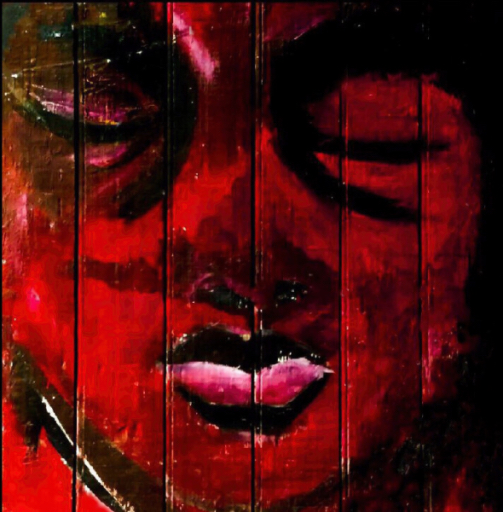
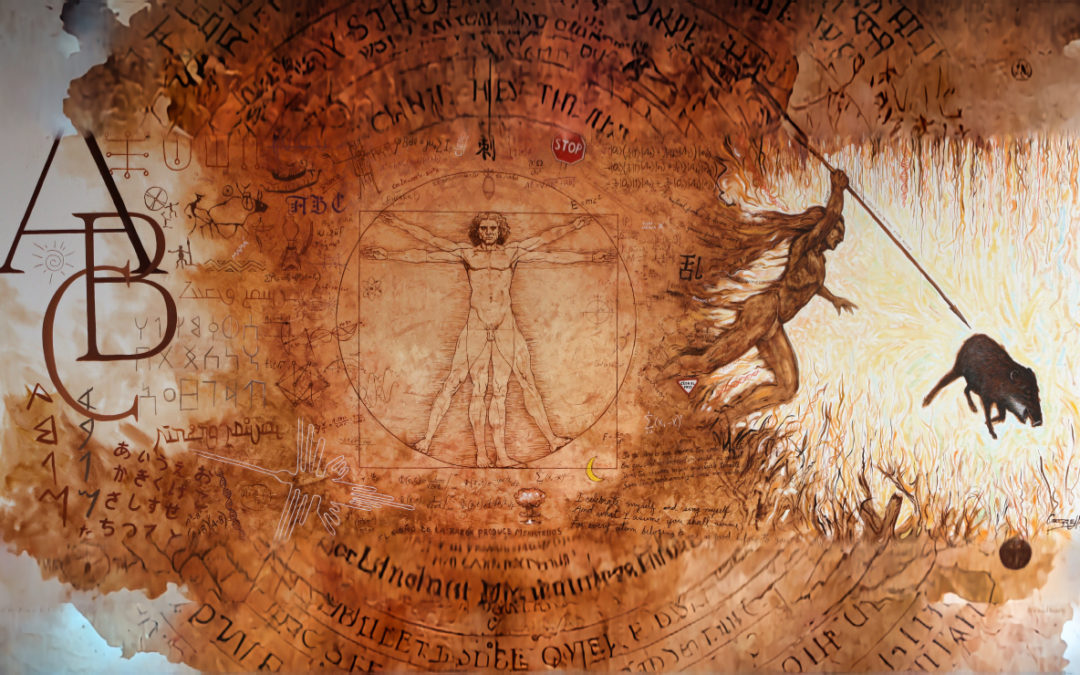
Gino Ceccarelli, Evolution, Amazonian Art
The Expansion of Being
Part 1: On the History of a Western Perspective
“For us, rivers, mountains and animals are not possessions or commodities.
They are our relatives, with whom we stand in a constant dialogue of respect.”
Ailton Krenak, indigenous philosopher, author and activist
Imagine we are standing in the Amazon rainforest. To the Western eye, it often appears as a collection of objects: trees, plants, animals, earth. But for the indigenous peoples who have lived in this world for millennia, what surrounds them is not an it – it is a you.
The jaguar is not a predator in a food chain, but a self with its own perspective, experiencing the world as subjectively as we do. The river is not merely a body of water, but a lifeline, an ancestor, a storyteller. In this worldview, the forest thinks.
One’s own existence does not stand apart from the world, it unfolds within a web of relationships: with food, water, air, history, and with visible and invisible beings. The human being here is not a closed subject, but a node in a living network.
The world appears not as a stock of objects, but as a continuous process of resonance. Death does not mean annihilation, but transition. Time flows not only linearly, but also cyclically — as a movement of becoming and passing away in which everything is held.
Belonging here is no abstract idea, It is lived reality
Indigenous Knowledge and the Animate World
This worldview, long dismissed in the West as “primitive animism,” is not a naive belief. It is a profound way of understanding reality, one that rests on the assumption that everything in existence has an interior: a standpoint, a form of experience, a way of being in relationship.
The rock paintings, body paintings, textile and ceramic patterns of Amazonian art are expressions of precisely this worldview. They are not decorations, not mere representations of nature. They are acts of participation, translations of the perspectives of other beings into a shared, creative language. Whoever contemplates them touches a way of thinking that the West has largely lost. But how did this come to be?
The Exiled Soul of Nature
Long before Western philosophy declared nature an object, the early great civilizations also lived in an animate world. The Epic of Gilgamesh, composed around 2100 BCE in Mesopotamia, tells of this in a deeply unsettling way.
The figure of Enkidu is the key. Created by the goddess Aruru from clay as a wild man bound to nature, Enkidu lives among the gazelles, eats grass and drinks at the watering hole alongside the animals. He is untouched nature itself.
But then he is “civilized” by the temple priestess Shamhat: she teaches him the arts of humans, gives him bread and beer, and clothes him. The price, however, is the irrevocable loss of his bond with nature: “The livestock fled from him. He could no longer keep pace with the animals.”
The epic is not a simple hero’s tale. It is a lament for the loss of belonging to nature, and perhaps the earliest literary warning of the consequences of human transgression against the natural world.
The most famous example of the Mesopotamian relationship with nature is the killing of Humbaba, guardian of the cedar forest. Humbaba is not an abstract danger, but the forest itself made flesh, a powerful, fearsome and yet divine presence.
Gilgamesh and Enkidu kill him out of ambition and hunger for glory, to fell the coveted cedars. The act is not simply celebrated as heroic. It is profoundly ambivalent, made clear by the fact that the gods punish Enkidu for it with death.
What the Epic of Gilgamesh condemns as hubris with death, the Bible turned into a divine mandate.
The Cosmos as Living Order
Pre-Socratic Cosmologies: From the World Soul to the Ghost in the Machine
Early Greek philosophy, too, knew no dead nature. The Pre-Socratics searched for the principles underlying the world and found them in living, penetrating elements: Thales in water, Anaximenes in air, Heraclitus in fire, not as mere substances but as carriers of an inner dynamic. The Logos in Heraclitus, the Pneuma in the Stoics, the World Soul in Plato: in all these concepts the cosmos is an ensouled whole. Nature and spirit are not opposites, but different expressions of the same reality.
Yet the history of European thought took a different path
Gradually it traded participation for possession,
and lost the experience of lived belonging
The Beginning of Separation and the Invention of the Outside World
This idea is not a universal law, but the result of a long intellectual development. It grew from a particular constellation of philosophy, theology and science. To this day it shapes our self-understanding and our relationship to the world, often without our noticing.
When the Sophist Protagoras declared in the fifth century BCE that “man is the measure of all things,” this was initially an act of epistemological liberation. Truth, he argued, is perspectival. It appears to human beings in the way they perceive it. In doing so, he stripped the gods of their sole authority over the interpretation of reality. It was a step toward the autonomy of thought, not toward dominion over the world.
A first step toward separation took place in Plato’s ancient philosophy. With his theory of Ideas he created a fundamental hierarchy: true, unchanging reality resides in the purely spiritual world of Ideas. The sensory world of nature is degraded to a mere reflection, and thereby reduced to a second-order reality.
In Aristotle the hierarchization solidified further into the idea of a graduated order of being. He still recognized continuity between plants, animals and humans, but human reason began increasingly to elevate him above nature. The human being stood at the summit, legitimized by reason. The nature beneath him became a means, not a counterpart.
The Loss of Reciprocity
In a polytheistic world, where gods, demons and spiritual beings exist, every human being understands that whatever they undertake can only succeed if they act in harmony with them. To win the favor of the gods, sacrifices were made, and in some cultures even human sacrifice played a role.
Life in an animate world is a constant give and take. Everything I do touches an invisible but living and very real power, one that has its own interests and whose help I will need. It would be foolish not to align oneself with the spirits of the forest before setting out to hunt. I cannot kill an animal, fell a tree, harvest fruit without offering something in return, for I am not alone.
This polytheistic worldview was widespread across most known cultures. As far as we know, virtually no culture assumed that the material world was dead and that human beings, as the only higher form of life, could act without respecting nature.
Against this background, the biblical idea of dominion over nature appears as a marked departure. In this attitude lies a peculiar self-empowerment. The human being is no longer embedded in a living cosmos, but placed as lord over creation. This idea runs through an influential line of interpretation in parts of the Hebrew and Christian tradition, displacing reciprocity in favor of a thinking of dominion and appropriation.
From the animate cosmos there gradually arose the idea of an outside world
that exists apart from the self
What was once living and connected became something foreign,
and finally a resource
The Expulsion from the Garden
In the Christian Middle Ages, God was the absolute point of reference for all order. Human beings were required to fit into a predetermined divine hierarchy. At the same time, the biblical tradition contained a passage of far-reaching consequence: “Subdue the earth” (Genesis 1:28). This mandate of dominion was long understood as a responsibility of stewardship. But with the beginning of the modern age, its interpretation changed.
The Judeo-Christian tradition deepened the growing rift by giving it a theological dimension. In many expressions of Western Christianity, God now appeared as a creator who stands outside his creation. With this idea, the sacred withdrew from nature. The divine shifted into a transcendent sphere.
Central to this worldview is the motif of expulsion. The human being loses the Garden of Eden, the place of original closeness to God and to the earth, and finds himself in a reality marked from then on by alienation. Nature is no longer an ally, but something foreign that must be worked and overcome. Labor takes the place of relationship.
Bound up with this is a deep distrust of the bodily. Corporeality and sensuality fall under suspicion, as does the abundance of nature. It appears as something that must be restrained so that the spirit may unfold.
The Renaissance: The Human Being at the Centre
In the Renaissance, Protagoras was rediscovered, but under new auspices. From the insight into the perspectival nature of human knowledge there gradually emerged a revaluation of the human being itself. No longer merely as a knowing subject, but as the centre of all order.
What in antiquity had begun as epistemological humility, that we can only experience the world through our human perception, became in the Renaissance a cultural claim to order it according to human standards. The human being became not only observer, but shaper; not only interpreter, but architect of reality.
Pico della Mirandola: The Invention of Human Freedom
Giovanni Pico della Mirandola (1463–1494) gave a decisive impulse to Western self-understanding. In his celebrated oration On the Dignity of Man he claimed that God had created the human being as the only creature without a fixed place in the order of nature.
While animals and plants are bound to their essence by instinct and natural law, the human being was elevated to “sculptor and moulder of himself.” Pico celebrated this as the highest dignity: the human being is the creature that can choose its own nature.
What began as liberation from medieval constraints sowed, however, the seed of later alienation. Here the human being became the eccentric of creation. He no longer belongs to it as a matter of course, but stands before the world as an autonomous shaper. Human dignity was henceforth defined by its distance from nature. He is no longer part of the chorus of living beings, but the director who governs the scene from above.
Leonardo da Vinci: The Last Animate Thinker
Leonardo da Vinci (1452–1519) still regarded the earth as a living organism. For him, water was “the blood of the earth” and the rocks its bones. His machines were not dead mechanics, but imitations of nature, inspired by the flight of birds, the flow of water, the structure of the skeleton.
Leonardo is the last great mind before the dualism of Descartes split the world definitively into spirit and dead matter. In Leonardo the machine was still animate and nature still profoundly intelligent.
His Vitruvian Man was later turned into the symbol of another age, one that elevated the human being to the measure of all things. But in Leonardo himself this drawing did not represent dominion, but harmonious integration: the human being as part of the divine geometry of nature.
The Alienation of the Senses
In the animate world, hearing was the most important sense. People listened to the wind, the creaking of the timber, the murmur of the river. Everything was a message, a call. The world was a space of resonance. With the Enlightenment, the eye became sovereign. The eye distances. When I look at something, I am not part of it. I stand apart from it. The world became panorama, surface, object. A forest can only be felled without emotion when one has stopped listening to it and begun to see it merely as a view or a building site.
Before reification, people thought in analogies. As Leonardo taught: water is the blood of the earth. This was not a mere metaphor, but the deep certainty of a universal kinship. Modernity replaced analogy with function. A tree is no longer a lung of the earth, but a biological machine for photosynthesis. With this, compassion disappeared: one feels no pain at the damage of a function, only at the wounding of a relative.
The reification of the world was more than a new theory. It was an alienation of the senses. We stopped experiencing the earth as something that speaks to us, and began to regard it as a canvas to paint on, or a warehouse to plunder. The forest lost its voice and became a timber reserve. The river lost its soul and became a transport route. As the spirits faded, so did the reluctance to destroy. Whoever disenchants the world makes it calculable, but also lonely. Where nothing is sacred, everything is permitted.
Galileo Galilei: The Mathematical Nature
Galileo Galilei (1564–1642) gave this new attitude its decisive scientific form: he claimed that the “book of nature” was written in the language of mathematics. In doing so he performed a radical division of the world: he distinguished between the measurable properties of matter (such as size and weight) and the merely felt qualities (such as color, taste or scent).
What could not be calculated lost reality from that point on. Qualities became quantities, immediate experience mere measurements. Nature was stripped of its sensuality; it was no longer a “you” that speaks to us, but a mute object to be compressed into formulas. With Galileo began the fateful conviction that the world is only “true” when it appears in a table. Living reality became mathematical abstraction.
Measure and Excess
Nature lost its sacred status. It was no longer understood as an animate cosmos or living totality, but increasingly as an object of human use and transformation.
Here lies the real turning point: not gods, not natural forces, but the human being with his reason and his interests became the central point of reference for truth and value. A development that gave rise to Western humanism.
The human being, capable of reason, self-determination and creation, moved to the centre of education, art and science.
But this very claim carried within it the seed of its own critique. Whoever makes the human being the measure must ask which human being is meant, and who pays the price.
Humanism
Erasmus of Rotterdam (1466–1536) embodies the spirit of early humanism in a time of growing tensions. As a scholar and sharp observer of his age, he criticized the rigidities of the Church without rejecting it outright. In his work In Praise of Folly he exposes with fine irony the abuse of authority, the empty formalism of faith, and the self-certainty of an institution that believes itself in possession of the truth.
Erasmus does not advocate rupture, but return: to an inner piety, to learning, to a way of thinking that does not rest on dogma alone. In doing so he prepares the ground for an attitude that would later gain weight: truth is not only inherited, it must be examined. In this sense Erasmus stands at the beginning of a development that lastingly transformed European thought. He still holds to the unity of the Church, but his doubt about its infallibility is already a first step. Not loud, not radical, but effective.
From the Quill to the Sail
But while minds like Erasmus were still pleading in their studies for a reform of the soul and a return to humility, very different facts were being created on the coasts of Europe. The humanist discovery of human dignity collided with the hard reality of geopolitics and the hunger for power, glory and gold.
Erasmus does not criticize institutions in order to destroy them, but to awaken the human being within them. He is the last attempt to heal the system from within, before colonial expansion and the claim to absolute power take over.
While Erasmus fought the folly of the powerful with the quill, they set sail. 1492 was not merely a discovery. It was the first serious test of a new worldview: the conviction that the world belongs to whoever knows how to use it.
From Balance to Dominion
The history of the domination of nature is a collective narcissism with consequences we measure daily and feel everywhere. Poisoned soils, a destabilized climate, the extinction of entire species. The human being, biologically speaking a young and resource-intensive guest on this planet, has appointed himself master of the house and is beginning to undermine the foundations of his own existence.
Other cultures have known other ways. In the cosmologies of many indigenous peoples the human being appears not as dominator but as participant, embedded in a web of living relationships that sustains him and that he in turn sustains. No idyll, no utopia. But a different relationship to the world, one that over long periods of time has led to more stable forms of coexistence.
What is truly unsettling is not the presumption itself, but how difficult it is to recognize it as such. Those raised within this mindset take it for granted. It is so deeply ingrained in the way we view the world that we scarcely perceive it at all.
This attitude is not an anthropological constant, nor an inevitable fate of the human species. It is a historically evolved, culturally shaped idea that developed in Europe with particular consequence and from there was carried into the world with Bible and sword.
