The Expansion of Being Part III
The Requerimiento: The legal Assault
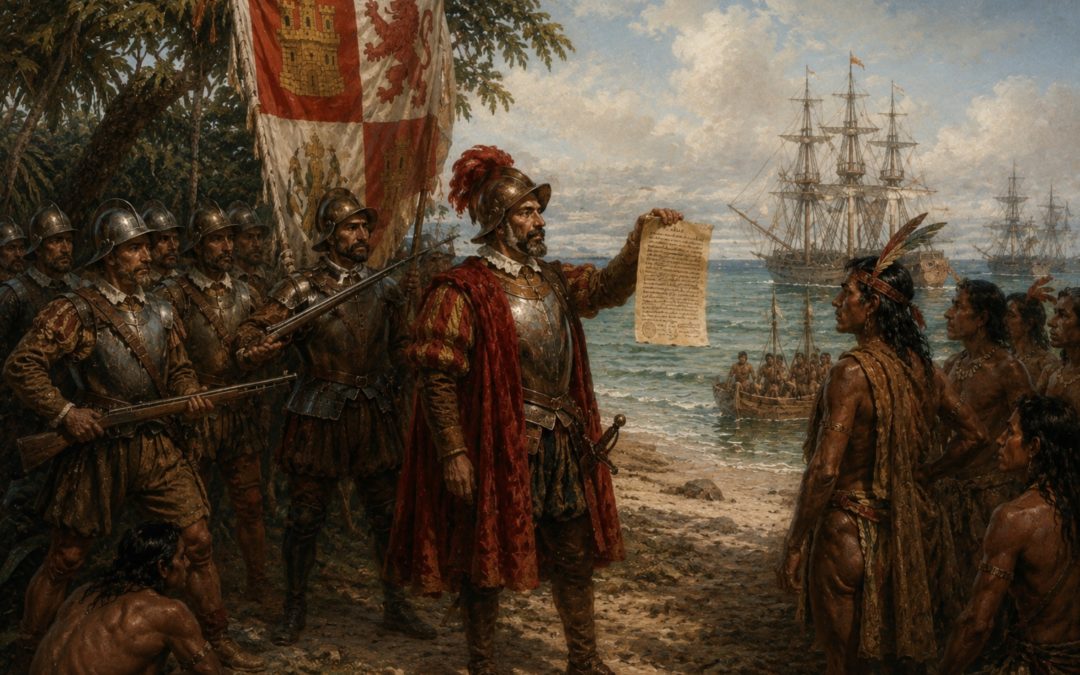
The Requerimiento of 1513 was a legal document issued by the Spanish Crown to formalize its claim of sovereignty over newly reached territories. Its practical application illustrates how legal procedures were used, within the context of the conquest, to legitimize violence. Contemporary accounts of this ritual reveal the almost surreal and deeply perverse nature of this legal construct.
Upon arriving at a place intended for conquest, a text was read aloud to the assembled Indigenous population in Castilian, a language they did not understand, while the soldiers already stood ready with their weapons. Since no one present could comprehend the language, the document was never intended as an act of communication, but rather as a formal record of an alleged refusal to submit. The text demanded immediate submission to the Pope and the Crown of Castile. Silence, incomprehension, or even natural hesitation were officially interpreted as resistance.
The Requerimiento was often read to the sound of drums or trumpet calls, from the safety of ships anchored offshore or from the top of a nearby hill. According to the conquerors’ own accounts, it was at times even recited quietly in the forest or before abandoned huts.
The Requerimiento marked the beginning of the bureaucratization of assault as a mechanism for legitimizing violence. What mattered was not whether the declaration had been heard or understood, but that a royal official or notary formally certified that it had been read, while the massacre was already underway. Justice was replaced by certification, serving as an administrative shield against future moral accusations.
Thus, a pretext was created through which violence became formally legitimized. This “legal act” was official, recorded in writing, and recognized as legally valid. That the procedure was entirely absurd and devoid of logic or justice was considered irrelevant. What mattered was procedure, not justice.
The Reversal of Responsibility
The most disturbing aspect of the Requerimiento was its final legal formula. In essence, it stated: “If you do not submit, I declare that all deaths and damages that result will be your own fault and not that of His Majesty or mine.”
With this clause, colonial logic achieved a radical displacement of responsibility. Resistance to an incomprehensible demand was redefined as a crime, and the assault itself was transformed into a punitive action. A legal fiction of self-inflicted guilt was thus established.
It did not matter whether the proclamation was understood or even heard; what mattered was only that a royal official or notary certified its formal reading. Justice was replaced by certification. The act of violence acquired its legal framework while it was taking place. Here, the need to preserve formal order even in the act of killing becomes especially visible.
The most degrading aspect of all this is the moral dispossession. Indigenous peoples were not only stripped of their land and their lives, but also of the right to be recognized as victims.
The New Laws (Leyes Nuevas)
In 1542, the Leyes Nuevas were enacted. They were the Spanish Crown’s response to reports of widespread violence in the New World. Peru was effectively governed by the Pizarros and other conquistadors as if it were a private territory. The Crown recognized that a new and largely uncontrolled power structure had emerged there. Charles V therefore created the office of the Viceroy in order to contain this development.
Blasco Núñez Vela was appointed because he was regarded as uncompromisingly loyal and as a strict enforcer of royal authority. He was not a diplomat, but a man of order. The new laws were intended to bring the encomienda system under direct Crown control.
The decisive point was the prohibition of inheritance. For the conquistadors, the encomienda had become their family wealth, effectively their “title of nobility” in the New World. Charles V’s decree that an encomienda would revert to the Crown upon the holder’s death was perceived by the settlers as a declaration of war. They saw themselves deprived of the fruits of their (bloody) labor.
By declaring Indigenous peoples “free vassals of the Crown,” the Emperor removed them from the direct control of the settlers. This formulation may sound humanitarian, but it was grounded in a strict fiscal logic: only free vassals were permitted to pay tribute (tributos) directly to the King. Charles V did not want gold flowing into the pockets of the encomenderos, but into the royal treasury in Madrid.
It was precisely these laws that led Emperor Charles V to appoint Blasco Núñez Vela in 1544 and send him to Lima; he did not go as a diplomat, but as an uncompromising enforcer of these decrees.
The First Viceroy in Lima
When the Viceroy arrived in Lima in 1544, he immediately began enforcing the Leyes Nuevas. He freed enslaved Indigenous people in the ports and ignored the protests of the settlers. He treated the conquistadors as subordinate and criminal subjects.
Illán Suárez de Carbajal, as royal factor and treasurer, was one of the Crown’s most important representatives on the ground. On the night of 13 September, Núñez Vela had him summoned to a secret meeting in the palace. A dispute arose over questions of loyalty and power within the colonial elite. When Carbajal defended himself, the Viceroy lost control and killed him with a dagger. The body was then thrown out of a window onto the Plaza Mayor and publicly displayed. The man who had come to enforce the “law” of the Crown and the “morality” of the Leyes Nuevas had himself become the murderer of a royal official.
With this act, he made himself permanently detested by the local elite and especially by the circle of the rebellious Gonzalo Pizarro. The conquistadors were not willing to surrender their acquired possessions to a distant king. This action undermined the authority of the law itself. The settlers could now argue that they were not rebelling against the Crown, but against a “tyrant.”
They could claim they were not opposing the king, but only a “tyrant.” Historians such as Prescott or Del Busto note that during his short and turbulent tenure, Núñez Vela had dozens of Spaniards executed, always under the justification of upholding royal authority.
Revenge
Benito Suárez de Carbajal, brother of the murdered man and himself an influential conquistador, joined the rebels under Gonzalo Pizarro out of rage. He was not a minor soldier, but a leader who embodied the interests of those men who had conquered the land and were unwilling to surrender their spoils on the basis of a piece of paper from Madrid. He used his influence to draw other hesitant nobles over to the rebel side.
At the Battle of Añaquito (1546), it was Benito who recognized the already wounded Viceroy on the battlefield. An enslaved man was ordered to behead him. The Viceroy’s head was carried through Quito on a pike and displayed in the central square. Benito Suárez de Carbajal attached the dead man’s beard and moustache hairs to his hat as a trophy.
The Victory of Silver over Ethics and Morality
The Leyes Nuevas were the result of a long struggle over the moral and legal responsibility of the Spanish Crown. A decisive influence came from Bartolomé de las Casas, who spent decades campaigning against the mistreatment of Indigenous peoples and calling for reform.
Yet in Peru, a stance emerged that became proverbial: “Obedezco, pero no cumplo” (“I obey, but I do not comply”). The authority of the Crown was formally acknowledged, but its orders were effectively ignored, while there was also a willingness to act against its representatives.
However, it was not only settler resistance that undermined the reforms. With the discovery of the silver mountain of Potosí in 1545, the key interests of both the Crown and the settlers shifted so dramatically that the enforcement of the Leyes Nuevas soon became a mere formality. Potosí became one of the largest silver centers of the early modern period and a driving force of imperial wealth, reshaping the entire economic logic of the colonial system.
Contemporary and later accounts describe the city as a place of extreme contrasts, where immense wealth and profound suffering existed side by side. Thus emerged the image that one could build a bridge of silver from Peru to Spain—and alongside it, another bridge made of the bones of those who lost their lives in the mines.
New Laws, New Rules of the Game
With sudden clarity, the true economic scale of the colonies became visible. The Crown realized that it depended on the encomenderos as key agents of exploitation in order to extract this wealth. The Indigenous population could not be freed while, at the same time, large-scale extraction of these resources was to be secured.
The stakes involved had become too great to be jeopardized by decrees directed against the settlers. The Leyes Nuevas allowed the Crown to present itself as a moral protector, while ships loaded with silver continued to arrive in Seville and exploitation proceeded without interruption.
What this conflict was truly about thus becomes clear: not morality or law, but the question of who controls wealth and power. The Crown’s reforms attempted to regulate a system that had long developed its own interests—and it was precisely here that they failed.
The Valladolid Debate
As reports of extreme violence, enslavement, and massacres in the New World multiplied, King Charles V ordered in 1550 that all military expansion in the Americas be suspended until a junta of fourteen respected theologians and jurists could resolve a fundamental question: Is it lawful to wage war against the Indigenous peoples in order to evangelize them?
This was not a true break with expansion, but rather a moment of uncertainty: moral doubts about its legitimacy were raised, and both Church and Crown were confronted with the perceived ideological contradiction between Christian universalism and colonial reality.
However, historical accounts suggest that there was neither a genuine moral dilemma nor an actual contradiction, but rather that one was the consequence of the other.
The Crown was increasingly concerned that the conquistadors were becoming too independent. Many acted entirely on their own authority, and control over them was slipping. Figures such as Francisco Pizarro had effectively established autonomous power structures. In Peru, violent struggles for power even broke out among Spaniards themselves after the conquest. The debate thus also reflected an attempt to reassert royal authority and bring the colonial enterprise back under centralized control.
The “Soul” of the Kingdom
Bartolomé de las Casas was particularly influential, openly denouncing the atrocities. His writings not only questioned colonial practice, but also the very legitimacy of conquest itself. He advocated for Christian evangelization without violence.
As early as 1514, he had recognized the injustice of these practices, renounced his encomiendas, and devoted his life to defending Indigenous peoples against colonial exploitation.
Francisco de Vitoria, in turn, systematically argued that Indigenous peoples were the legitimate owners of their lands. If this was accepted, many of the conquests became legally and morally questionable. For Charles V, this became a problem not only of politics but also of religion, as he understood himself to be a Christian ruler.
The Empire’s Reputation Before Europe
Reports of atrocities not only threatened this self-image, but also the legitimacy of the empire in Europe. Spain was in competition with England, France, and the Netherlands. Rival powers drew on the writings of Las Casas to portray Spain, in the so-called “Black Legend,” as a particularly brutal colonial power. The Crown was therefore compelled to engage in this debate in order to preserve its standing in Europe.
What was at stake was the claim to moral leadership in the Christian world. At its core lay a dual form of sovereignty: the emperor’s moral sovereignty before God, and the Crown’s legal sovereignty over its own conquistadors, who had grown too powerful. Valladolid was meant to demonstrate that expansion was not a lawless campaign of plunder, but an orderly, state-directed process.
A formula was sought that would secure the wealth of the Americas without sacrificing the king’s prestige or Spain’s reputation in Europe. However, the Junta did not reach a definitive decision. The conquest continued, while the fundamental questions regarding its legitimacy and moral justification remained unresolved.
It was not a moral awakening, but a focal point shaped by
power, control, reputation and the fear of chaos.
The papal bull Inter caetera, issued by Pope Alexander VI on 4 May 1493 and used to legitimize the colonization of the Americas, predates the Valladolid debate (1550–1551) by more than half a century.
This temporal reversal reveals the extent to which papal decrees were politically instrumentalized. The Pope (himself Spanish, from the Borgia family) did not act as a neutral authority, nor as a vessel of divine inspiration, but rather as an extension of the Spanish court in Rome.
The Perspective of the Subjugated
Felipe Guaman Poma de Ayala (c. 1535 – after 1616)
While Europe debated the law, morality, and legitimacy of the conquest, another perspective was taking shape at the same time: the voice of those who lived under its rule.
Felipe Guaman Poma de Ayala’s Nueva corónica y buen gobierno comprises approximately 1,200 pages and includes 398 drawings executed by the author himself. It is the only known colonial-era manuscript to have been both written and illustrated entirely by an Indigenous author.
Guaman Poma addressed his work directly to King Philip III of Spain as a formal indictment. Its purpose was to demonstrate that it was not the Crown itself, but the colonial officials on the ground, who violated both divine and royal order by exploiting and killing the Indigenous population.
A substantial portion of the manuscript is devoted to the Inca period. Guaman Poma portrays it not as a “pagan” past, but as a just and well-ordered society that, in his view, was also in harmony with divine order. In doing so, he reaffirmed the legitimacy of the Indigenous nobility, to which he himself belonged.
The manuscript disappeared into the Spanish archives for centuries. It was not rediscovered until 1908, when the German scholar Richard Pietschmann found it in the Royal Library of Copenhagen. A critical edition was finally published in 1936—more than 320 years after its completion.
Felipe Guaman Poma de Ayala. Nueva corónica y buen gobierno. Um 1615. Royal Library, Copenhagen.
Inca Garcilaso de la Vega (1539–1616)
The Mestizo as a Cultural Bridge
He was the son of a Spanish conquistador and an Inca noble princess. Raised in Cusco speaking both Spanish and Quechua, he moved to Spain in 1560, where he lived as an educated mestizo within Spanish society.
In his work, Garcilaso portrays the Inca state as an idealized, peaceful, and civilized monarchy—a utopian counterpoint intended to criticize the brutality of the conquest without directly challenging the Spanish Crown. Unlike Guaman Poma, who wrote as a subject denouncing injustice, Garcilaso wrote from the position of a cultural mediator, standing between two worlds and seeking to understand both.
The first part of his Comentarios Reales, published in 1609, was printed and widely read in Europe during his lifetime. For centuries, however, it was dismissed as a romanticized account. Only modern ethnohistory came to recognize its value as a unique source that combines Indigenous oral traditions with European scholarship.
The works of Guaman Poma and Garcilaso demonstrate that the Indigenous voice had not fallen silent. It simply found other forms of expression—as an indictment, as remembrance, and as a bridge between cultures. Both addressed the same Europe that debated the souls of Indigenous peoples in Valladolid without ever allowing them to speak for themselves.
Inca Garcilaso de la Vega. Comentarios Reales de los Incas. Lisbon, 1609.
But while Europe sought to justify the conquest of the Americas in legal, moral, and theological terms, the very order upon which it had based its own claim to truth was beginning to crumble within Europe itself.
The Reformation shook the unity of Christianity. Religious wars devastated the continent. The authority of the Church began to falter. And even the Earth lost its long-held place at the centre of the universe.
A new question began to emerge: if the old certainties no longer held, on what could human beings base their knowledge of the world?
The answer would fundamentally transform Western thought. And with it, humanity’s relationship with nature…
Continue reading in Part IV: The Early Enlightenment
