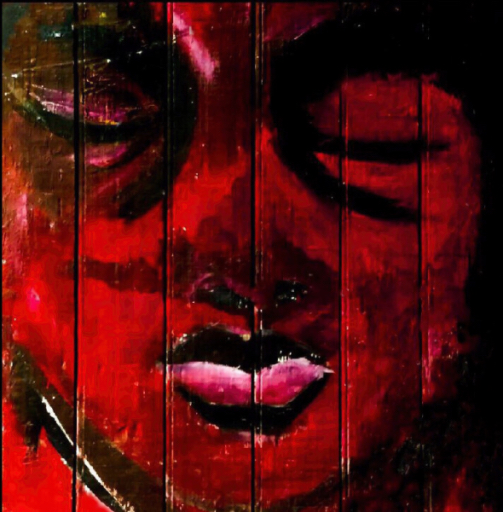
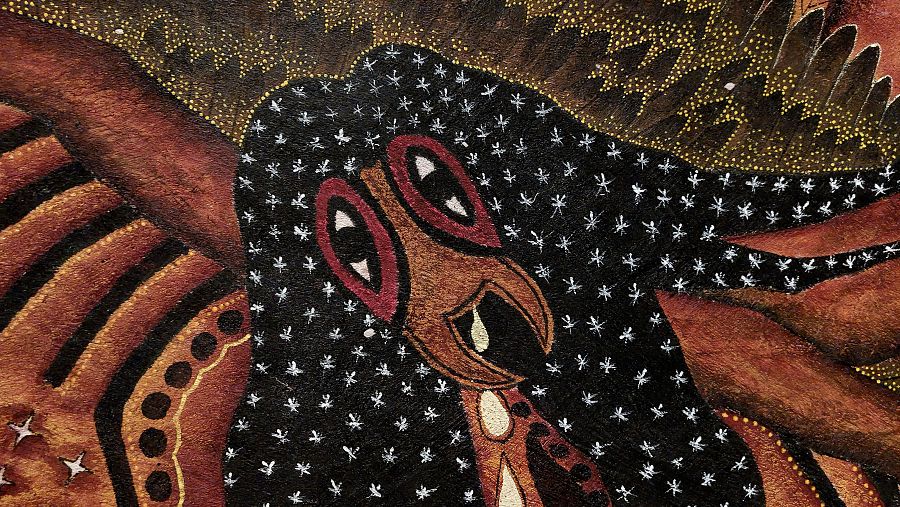
Santiago Yahuarcani. A visionary face emerges from a night sky woven with stars — a spirit figure where memory, cosmos, and ancestral presence meet.
Contemporary Indigenous Art of the Amazon
A Pioneer of Contemporary Indigenous Art
Santiago Yahuarcani
“There is a world different from the Western one, still waiting to be explored. It is only just being discovered… Hopefully, we will still have time to share it.”
As an artist, the voice of his people, and a guardian of cultural memory, Santiago Yahuarcani is not only a pioneer of contemporary Indigenous art but remains one of its driving forces to this day. In his work, he forges a visual language that is at once political, poetic, and deeply spiritual.
Resistance in a World of Change
Santiago’s paintings are both testimony and renewal. They recount displacement, colonial trauma, and the loss of land and culture – and at the same time, what endures and is continually reborn.
A steady stream of images unfolds, a play between grief and hope, between dream and history. Thus, Yahuarcani’s works become a living map of the soul.
They invite us to recognize the inner connection that encompasses past, future, humanity, and nature.
His works visualize the profound interconnection of all living things in an encompassing cosmos. They give voice to those who draw their knowledge from millennia of connection with nature.
Ultimately, his art honors the unbreakable resilience of the human spirit.
From this balance between preservation and change emerges a creative force that opens sustainable paths into the future in a changing world.
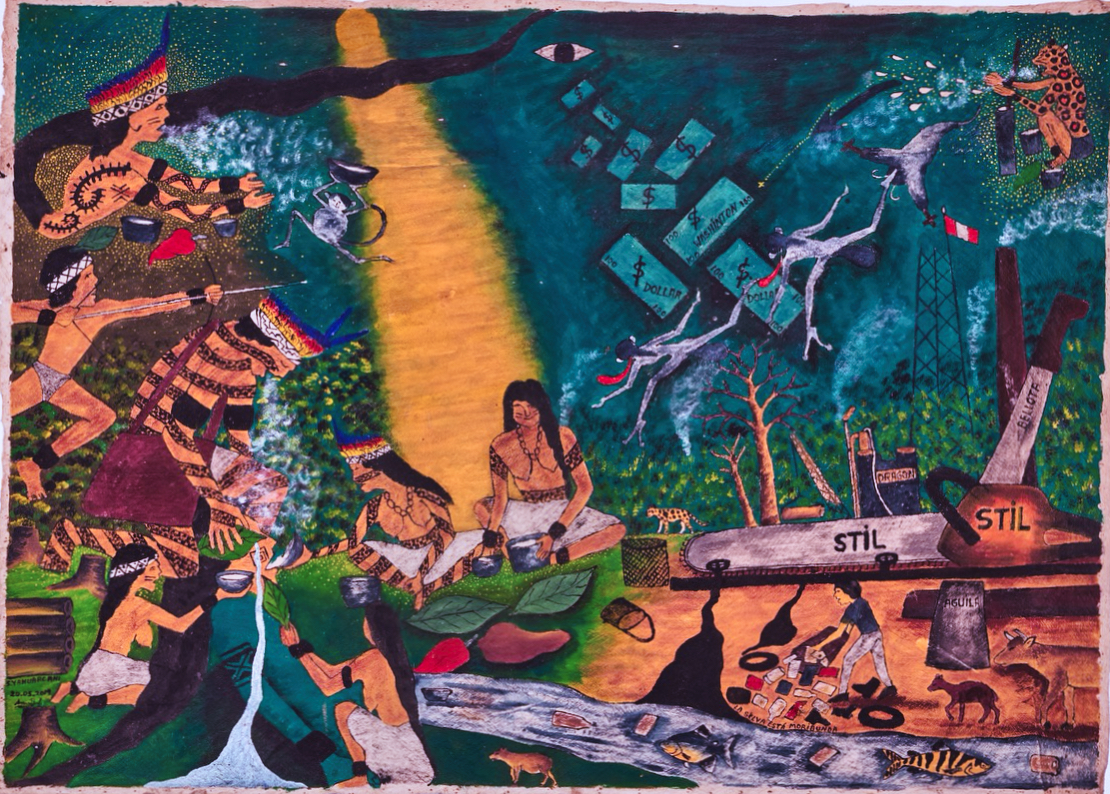
Santiago Yahuarcani, portrays two opposing worlds: the luminous presence of ritual, memory, and forest spirits, and the encroaching machinery of extraction. His painting becomes a warning and a testament — a call to protect the living knowledge that sustains the Amazon.
Art, Healing and Resistance
These works serve far more than as mere exhibition pieces or museum objects. They preserve collective memory, carry forward spiritual traditions, and open paths to healing the scars of colonial history, social injustice, and ongoing discrimination.
In this way, they give voice to those protecting the rainforest, resisting displacement, and fighting for their ancestral homeland. More than artistic expression, they are a pulse from a people’s soul, carrying the heartbeat of unbroken vitality.
Amazonian Indigenous art strengthens entire generations’ self-confidence. It retrieves suppressed knowledge from the shadow of Western disdain and transforms it into proud self-representation, a space where traditions are not just preserved, but reclaimed.
With his unique approaches and deeply moving visual language, Santiago Yahuarcani has shaped contemporary Indigenous art from the start. Born from his creativity, it remains powerfully present and enduringly relevant.
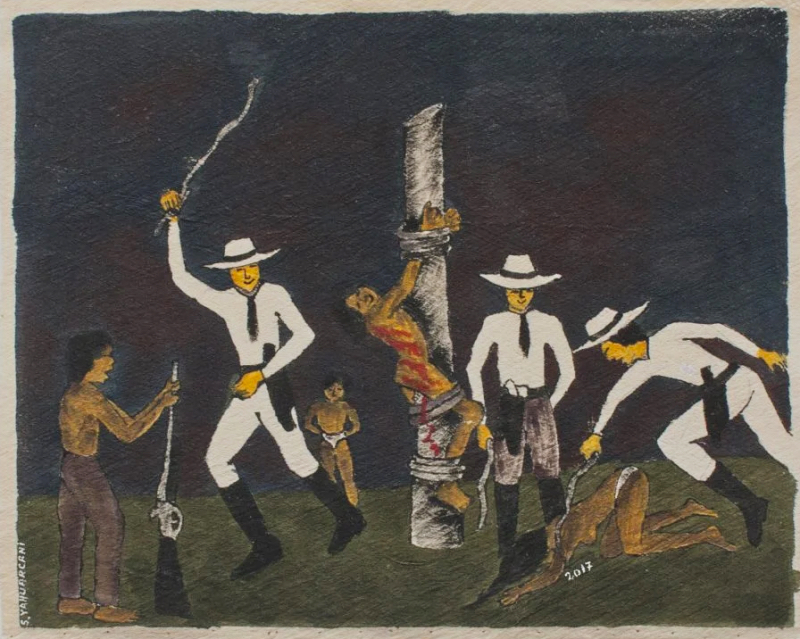
Santiago Yahuarcani, Castigo del caucho, 2017. A haunting depiction of the Putumayo rubber boom atrocities.
The Voice of a People on the Global Stage
Santiago’s brush exposes colonialism, makes the voices of the ancestors audible, and honors those who protect the rainforest, resist displacement, and defend their land. His art is both an indictment and a powerful reminder—a moving plea for the dignity, recognition, and the right to self-determination of his people.
His works preserve the memory of the enslavement of the Uitoto people during the rubber boom (Putumayo genocide 1879–1912). This horror, which his grandparents themselves witnessed, has left a lasting impression that remains indelibly visible in his art to this day. It is both a tribute and a legacy that honors the suffering and dignity of the victims.
These images profoundly challenge our society. They demand that we confront the shadows of a past whose echoes have not fallen silent to this day. They call for self-awareness and a new historical consciousness. Santiago’s brush transforms silence into testimony and memory into a living, challenging present that confronts us here and now.
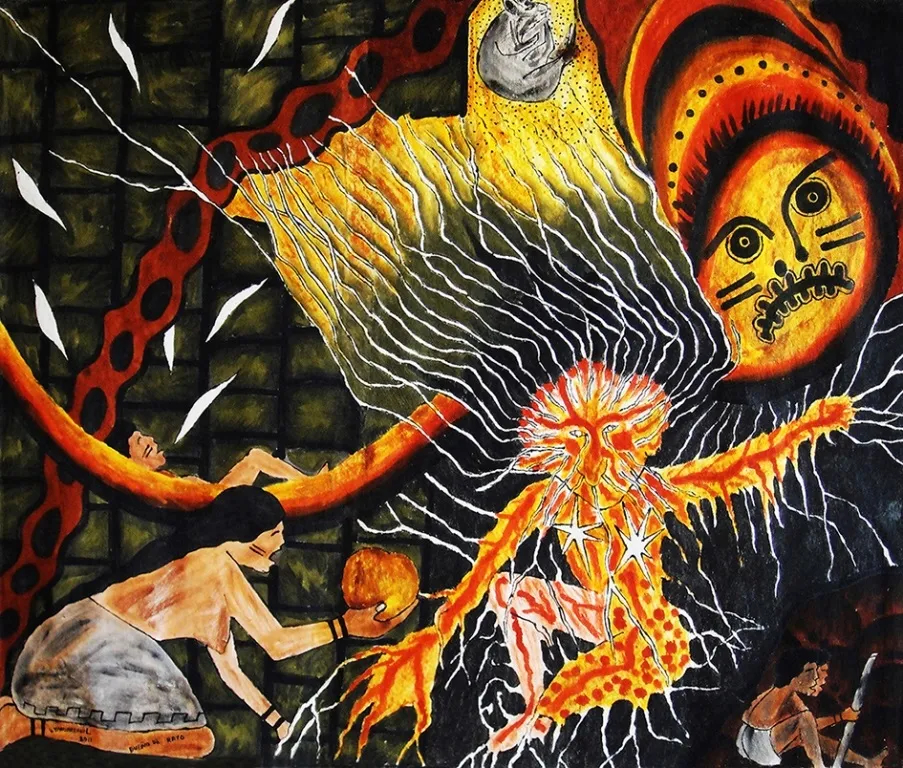
Santiago Yahuarcani reveals a world where myth, memory, and living energy continue to pulse beneath the surface.
From Oral Tradition to Contemporary Indigenous Art
Moving beyond a purely visual language, Santiago Yahuarcani forges a crucial bridge between oral tradition and contemporary art. His work has been presented internationally in major museums and at renowned biennials, consistently amplifying the voice of his community.
His distinguished exhibition history includes venues such as the Museo de Arte de Lima (MALI), the Museo Reina Sofía in Madrid, the Museum of Modern Art (MoMA) in New York, the Tate Gallery in London, the MASP in São Paulo, and the Van Abbemuseum in Eindhoven. He has also participated in the Biennale di Venezia, the Gwangju Biennale (2023), the Toronto Biennial of Art, and the Mercosur Biennale. Further institutions like the Whitworth Art Gallery in Manchester, the Stephen Friedman Gallery in London, and Kadist in Paris have also presented his art.
In these global forums, he does not merely represent his culture—he actively reclaims, questions, and redefines it, drawing strength from collective memory, lived experience, and his community’s vision for the future.
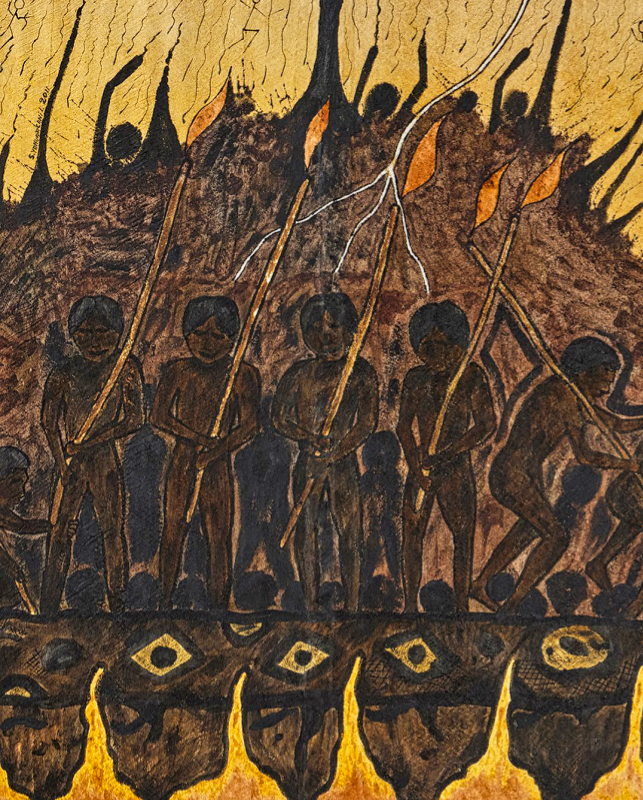
In this work, Santiago Yahuarcani evokes a procession of ancestral guardians advancing through a world shaped by fire, memory, and spirit. Their silhouettes echo across layers of earth and myth,
reminding us that the past still watches, and walks with us.
Art and New Horizons
Contemporary Indigenous art is a living, powerful expression of tradition, spirituality, and resistance. It is a powerful call for awakening that preserves dignity and achieves recognition.
The works narrate the wounds of an unprocessed history. They are a voice that does not silence the pain, but opens a space for healing. Within this space unfolds an emotional force that resonates onward, enabling a vivid re-presentation of the past.
What moves us in this art is not its harmony, but its authenticity. Its expressiveness and poetic power arise from its depth, intensity, and resilience. The works lay bare, without embellishment, historical fractures, the alienation from nature, and the darker sides of a civilization shaped by colonial roots. Bearing their cultural weight, they unveil uncomfortable truths and open spaces for contemplation and self-reflection.
The recognition of Indigenous art and thought as part of the global avant-garde opens up a deeper understanding of this world—and of our role within it. It is there, in this dialogue, that it finds its power and its place: not as a fading echo of the past, but as a living voice that invites us to see anew, to think differently, and to act more consciously—and in doing so, to encounter ourselves.
These essays explore the evolution of Indigenous artistic expression,
and its contemporary relevance
You can read them here.
