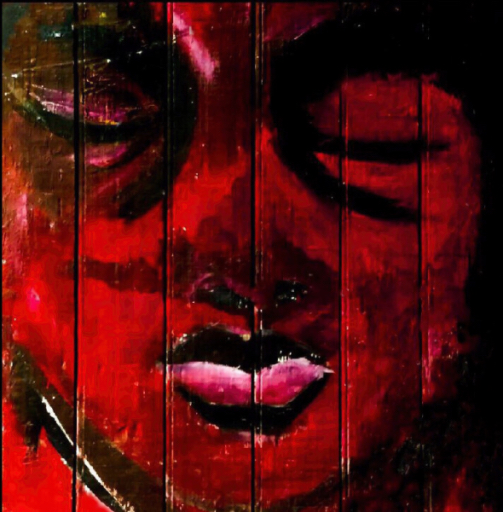
Insights
A place of encounter, reflection, and perspective
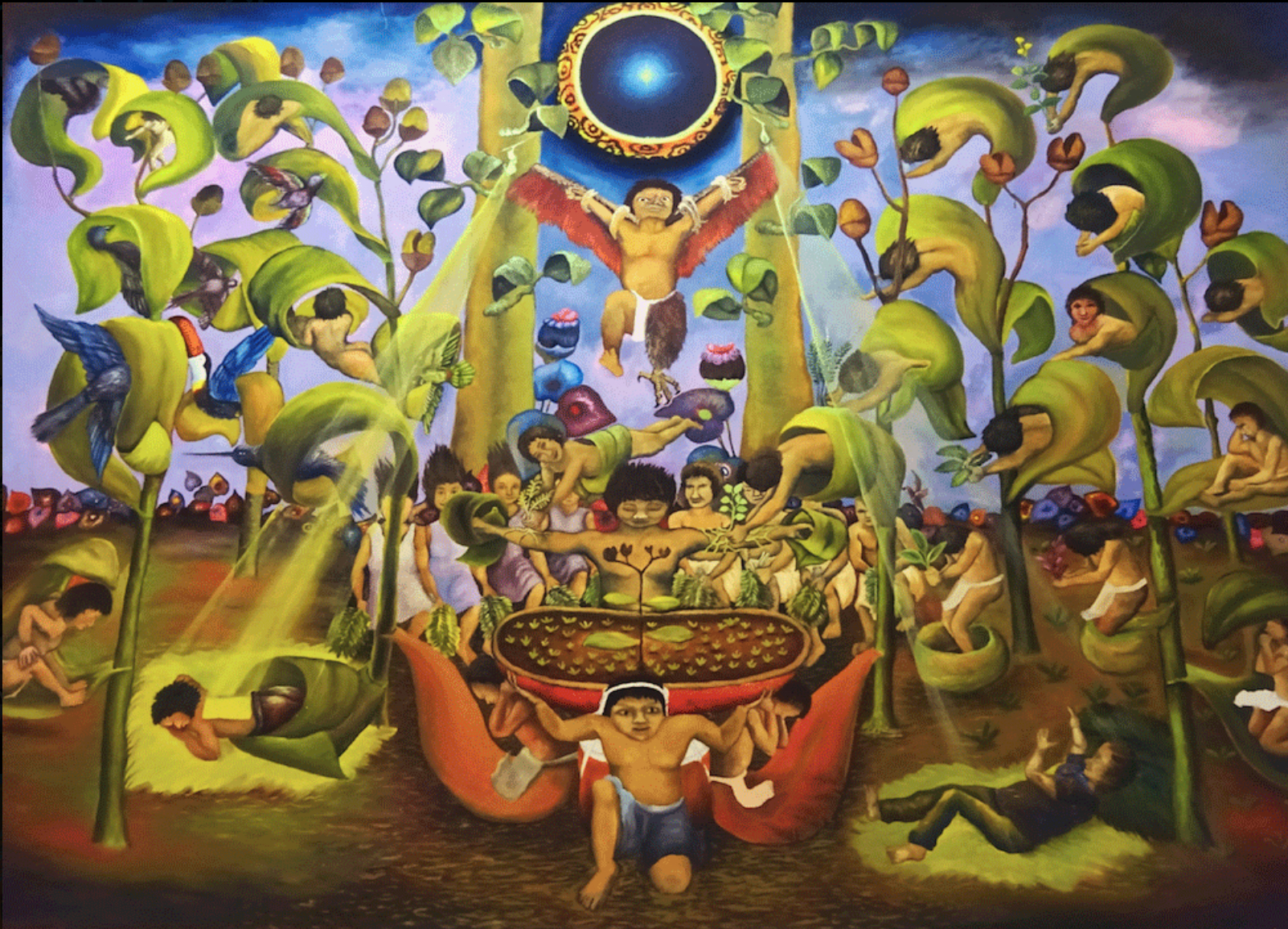
Brus Rubio, Contemporary Indigenous Art
Contemporary Indigenous and Amazonian Art
Impulses of the Present
How does one shape the future without losing the soul?
With this question, contemporary art of the Amazon raises one of the most essential questions of our time. It connects ancient knowledge with the challenges of the present and crafts from this a distinct vision for the 21st century.
When ancestral knowledge meets the global art world, something more than an artistic position emerges: a worldview takes shape that fundamentally challenges our notion of progress and expands it.
The artists are far more than creators of images or objects; they are bearers of living traditions and shapers of a distinctive present. Their shared drive is a deep, lifelong engagement with a changing reality. Their works are both root and wings – they invite us to feel, think, and see anew.
The Creative Act as Resistance
Indigenous artists adapt the formal language of contemporary art – yet they not only appropriate it, they subvert it. They fill the international format with the soul of the forest, the myths of their ancestors, and the urgency of their own place.
What appears global and contemporary reveals itself, upon closer examination, as deeply rooted in the cosmologies of the rainforest. Amazonian art is both translation and transformation: it speaks in universal forms yet preserves the pulse of tradition.
From Memory into the Future
Amazonian art is neither backward-looking nor affirmatively global, but rather a testament to radical contemporaneity. It embodies knowledge that draws from the past and points toward a necessary artistic and social future.
Its works are not isolated objects for distant contemplation. They resist separation from their social, political, and cultural context. Instead, they form ecologies of resistance and memory – living, interconnected expressions of another relationship with the world.
The limits of the knowable
Contemporary art of the Amazon poses anew the ancient question of philosophical aesthetics: Where lies the boundary between being and appearance, when we barely comprehend what consciousness truly is? Here, art becomes the language of the invisible, making the hidden perceptible.
It is not merely poetry, but expands human understanding through the capacity to feel and perceive more deeply. Art here is not representation, but knowledge: it reveals that consciousness which takes poetic form and from which all being springs forth.
Contemporary Indigenous and Amazonian Art:
a question of self-designation
This distinction respects the self-designation and sovereignty of the artists. It arises from distinct cultural, historical, and cosmological contexts in which artistic creation and identity are consciously shaped.
Contemporary Art from the Amazon
This term brings together Indigenous and Amazonian art and understands the Amazon not only as a geographic origin, but as a living cultural space in transformation. The title functions as an overarching framework that makes both artistic expressions visible in their autonomy and in their dialogue.
Within this framework, contemporary art of the Amazon unfolds in two currents. Indigenous art is an expression of an ancestral tradition, sustained by a spiritual worldview and inherited knowledge passed down through many generations. Amazonian art, on the other hand, is shaped more strongly by the modern experiences of the region—characterized by social changes, urban life, and contemporary influences that increasingly reach even the communities within the rainforest.
Although indigenous and Amazonian art emerge from different impulses, they remain closely connected. They face common challenges and navigate the tension between preservation and renewal, between tradition and change. Both engage with spirituality, mythology, and social realities, yet each does so through its own lens and visual language. This differentiation does not establish a hierarchy, nor does it set boundaries. Instead, it opens the viewer’s eye to a diversity of perspectives on a shared living environment in a changing present. They are linked not by sameness, but by the responsibility they carry toward their time.
Ancestral
Avant-garde
The Expansion of Being
Prologue
This text explores the nature-connected worldview from which Amazonian art emerges
and asks why it has become foreign to Western thought.
It traces how the separation between humans and nature developed in the West,
how it shaped consciousnessfor centuries, and continues
to influence our self-understanding today.
Yet a remarkable development is emerging.
Indigenous perspectives and new scientific insights are converging today in unexpected ways.
They challenge the dualistic worldview and lead back to that connectedness which
indigenous cultures never lost.
It is an invitation to see differently: not as observers of a world, but as part of it.
From the Separation from Nature to the Rediscovery of Belonging
Introduction
“For us, rivers, mountains and animals are not possessions or commodities. They are our relatives, with whom we stand in constant dialogue of respect.” – Ailton Krenak
Let us imagine we are standing in the Amazon rainforest. For Western perception, this is a collection of objects: trees, plants, animals, earth.
For the indigenous peoples who have lived in this world for millennia, however, what surrounds them is not an “it” but a “you.” The jaguar is not a predator in a food web, but a self with its own perspective that experiences the world as subjectively as we do. The river is not just a mass of water, but a lifeline, an ancestor, a storyteller. In this worldview, the forest thinks.
One’s own existence does not stand opposite to the world, but unfolds within a fabric of relationships – to food, water, air, history, to visible and invisible beings. Humans here are not closed subjects, but nodes in this network.
The world is no longer conceived as an inventory of objects, but as an ongoing process of resonance. Death means not annihilation, but transition. Time does not flow linearly, but cyclically – as movement of becoming and passing away in which everything is embedded.
Connectedness here is not an abstract idea, but lived reality.
The Experience of Belonging
Indigenous Knowledge and the Ensouled World
This perspective, long misunderstood in the West as “primitive animism,” is not naive belief, but a profound way of understanding reality. It is based on the assumption that everything that exists possesses an inner side: a standpoint, a form of experience, its own way of being in relationship. The world is not a juxtaposition of isolated things, but a dense fabric of mutual meanings.
This experience is not conceptual, but existential. It is felt in the body, lived in community, and celebrated in art. The rock paintings, body decorations, signs and symbols of Amazonian art, textile and ceramic patterns are not decorations, not mere representations; they are acts of participation, translations of the perspectives of other beings into a common, creative language.
In this cosmology there exists no fundamental separation between human mind and nature, between subject and object. Human, animal, plant and stone are participants in the same living whole – a reality that consists not of things, but of relationships.
The Cosmos as a Living Order
Pre-Socratic Cosmologies: From World Soul to Ghost in the Machine
Even in early Greek philosophy, the cosmos was no mechanical structure. The Pre-Socratics searched for the principles underlying the world and found them not in abstract forces, but in living, penetrating elements. Thales saw water as the all-connecting principle, Anaximenes air, Heraclitus fire – not just as substances, but as carriers of an inner dynamism and a law that forms the order of the world. Logos, the rational, ordering ground of being, first appears in Heraclitus and points to a reason that connects all phenomena.
Pneuma, as further developed by the Stoics, is not just a breath or breeze, but the penetrating life force that connects matter and spirit. The World Soul, finally, in Plato and later in the Neoplatonists, describes the cosmos as a unified, ensouled whole whose order expresses a spiritual structure. In this thinking, nature and spirit are not opposites, but different expressions of the same reality – a unity that was systematically broken apart only centuries later.
European intellectual history took a different path.
It gradually exchanged belonging for mere co-existence
and lost the experience of lived connectedness.
On the History of a Western Perspective
From the ensouled cosmos gradually emerged the notion
of an external world that exists separate from the self.
What was once livingly connected became the counterpart
and finally a resource.
Man as the Measure of All Things
This notion is not a universal law, but the result of a long intellectual development. It grew from a particular constellation of philosophy, theology and science. To this day it shapes our self-understanding and our relationship to the world, often without us noticing.
When the sophist Protagoras in the 5th century BCE declared “man is the measure of all things,” this was initially an act of epistemological liberation. Truth, according to his insight, is perspectival. It appears to humans in the way they perceive it. Thus he withdrew from the gods their sole authority to interpret reality. It was a step toward the autonomy of thought – not toward dominion over the world.
A first step toward separation took place in Plato’s ancient philosophy. With his theory of forms, he created a fundamental hierarchy: True, unchangeable reality lies in the purely spiritual world of ideas. The sensibly experienceable world of nature is degraded to a mere copy and thus to second-rate reality.
With Aristotle, the hierarchization solidified further in the conception of a graduated order of being. While he still saw continuity between plants, animals and humans, human reason began increasingly to elevate him above nature. Man stood at the top – legitimized by reason. Nature beneath him became means, not counterpart.
The Sacred Leaves Nature
The Expulsion from the Garden
In the Christian Middle Ages, the measure shifted once again. Now God was considered the absolute reference point of all order. Humans had to fit into a predetermined divine hierarchy. At the same time, however, the biblical tradition contained a consequential passage: “Subdue the earth” (Genesis 1:28). This mandate of dominion was long understood in terms of responsible stewardship. But with the beginning of the modern era, its interpretation changed.
The Judeo-Christian tradition intensified the emerging split by giving it a theological dimension. In many expressions of Western Christianity, God now appeared as a creator who stands outside his creation. With this conception, the sacred withdrew from nature; the divine shifted to a transcendent sphere.
Central to this worldview is the motif of expulsion. Man loses the Garden of Eden – the place of original closeness to God and to the earth – and finds himself in a reality that henceforth stands under the sign of alienation. Nature is no longer ally, but counterpart that must be worked and overcome. Labor takes the place of relationship.
In many expressions of this tradition, this is accompanied by a deep mistrust of the corporeal. Embodiment and sensuality come under suspicion, as does the fullness of nature. It appears as something that must be curbed so that the spiritual can unfold.
The Renaissance: Humanity at the Center
In the Renaissance, Protagoras was rediscovered – but under new auspices. From the insight into the perspectivity of human knowledge gradually emerged an elevation of man himself. No longer only as knowing subject, but as the center of order.
What began in antiquity as epistemological modesty – that we can only experience the world through our human perception – became in the Renaissance the cultural claim to order it according to human standards. Man became not only observer, but shaper; not only
Pico della Mirandola: The Invention of Human Freedom
Giovanni Pico della Mirandola (1463–1494) provided a decisive impulse for Western self-understanding. In his famous speech “On the Dignity of Man,” he claimed that God had created man as the only being without a fixed place in the order of nature.
While animals and plants are bound to their essence by instincts and natural laws, man was elevated to “sculptor and shaper of himself.” Pico celebrated this as the highest dignity: Man is the being who can choose his own nature.
What began as liberation from medieval constraints, however, laid the seed for later alienation. Here man became the “eccentric” of creation – he no longer belongs naturally, but stands opposite the world as an autonomous shaper. Human dignity was henceforth defined by his distance from nature. He is no longer part of the choir of living beings, but the director who stands above the sta
Leonardo da Vinci: The Last Ensouled World
Leonardo da Vinci (1452–1519), however, still regarded the earth as a living organism (Anatomia della Terra). For him, water was the “blood of the earth” and rocks its bones. His machines were not dead mechanics, but imitations of nature – inspired by the flight movement of birds, the flow of water, the structure of the skeleton.
Leonardo is, so to speak, the last great spirit before Descartes’ dualism definitively split the world into “spirit” and “dead matter.” In Leonardo, the machine was still ensouled and nature still highly intelligent.
His Vitruvian Man later became the symbol of another age – one that elevated man to the measure of all things. But in Leonardo himself, this drawing did not stand for dominion, but for harmonious embedding: Man as part of the divine geometry of nature.
Measure and Excess
Nature lost its sacred status. It was no longer understood as an ensouled cosmos or living context, but increasingly as an object of human use and design.
Here lies the actual turning point: Not gods, not natural forces, but man with his reason and his interests became the central reference point for truth and value. A development that brought forth Western humanism.
Man, capable of reason, self-determination, design, moved to the center of education, art and science.
But precisely this claim, which founded human dignity, also carried the seed of its critique. For whoever makes man the measure must allow himself to be asked which man is meant – and at what price.
From Observer to Architect
What began in antiquity as epistemological modesty – namely that we can only experience the world through our human perception – became in the Renaissance the cultural claim to order it according to human standards. Humanity became not only observer, but shaper – not only interpreter, but architect of reality.
Here lies the actual turning point: Not gods, not natural forces, but humanity with its reason and its interests became the central reference point for truth and value. A development that brought forth Western humanism.
Humanity, capable of reason, self-determination, and design, moved to the center of education, art and science.
But precisely this claim, which founded human dignity, also carried within itself the seed of its critique. For whoever makes humanity the measure must allow themselves to be asked which human being is meant – and at what price.
Galileo Galilei: Mathematical Nature
Galileo Galilei (1564–1642) gave this new attitude its decisive scientific form: He claimed that the “book of nature” was written in the language of mathematics. Thus he performed a radical separation of the world: He distinguished between the measurable properties of matter (like size and weight) and the merely felt qualities (like color, taste or scent).
What could not be calculated henceforth lost reality. Qualities became quantities, immediate experience mere data points. Nature was robbed of its sensuality; it was no longer a “you” that speaks to us, but a mute object that we press into formulas. With Galilei began the fateful conviction that the world is only “true” when it appears in a table. Living reality became mathematical abstraction.
The Disenchantment of the World
I Think, Therefore I Am, and the Rest is Matter
However, the decisive split is marked by early modernity in the philosophy of René Descartes (1596–1650): “I think, therefore I am” – and everything else is just matter.
With the Cartesian division, the separation between the thinking subject and extended, spiritless matter was radicalized. Man, equipped with reason and spirit, is elevated to the sole agent. The entire non-human world – animals, ecosystems, even one’s own body – becomes passive material that may be possessed, used and exploited.
This thinking provided the philosophical foundation for colonization: It declares the world commodity and man its master.
From Cosmos to Clockwork
This thinking found its perfect scientific form in the mechanistic worldview of Isaac Newton (1643–1727). The universe appeared as a calculable clockwork, governed by universal laws. What remained was mechanics; the question of meaning and experience became increasingly irrelevant.
Knowledge became synonymous with control; knowing changed from understanding to instrument of disposal. In this view, nature loses all interiority; it becomes calculable resource. Nature should no longer be understood, but made available and dominated. Newton’s Philosophiae Naturalis Principia Mathematica of 1687 is something like the founding text of this new ontological order.
Man as Owner, Nature as Property
The Cartesian split created the metaphysical foundation – three thinkers provided the political, economic and legal legitimation of this new order:
Francis Bacon (1561–1626) formulated the program of nature domination with relentless clarity: “Knowledge is power,” to put nature “on the rack” and make it useful. Nature is object of technical exploitation.
Thomas Hobbes (1588–1679) transferred mechanics to humans: state of nature as war of all against all. Security and property legitimize the strong state – a view of humanity that enabled colonial expansion.
John Locke (1632–1704) provided the legal foundation: land belongs to the “industrious” cultivator. Communally used indigenous land was considered terra nullius – masterless. Locke thus significantly influenced colonial land seizure.
The Enlightenment built upon this metaphysical and political foundation – with the claim to embody universal reason, which however bore a European face.
The Enlightenment
The Enlightenment of the 18th century proclaimed universal reason and human rights, but actually wrote both with European hands. What was considered universal was measured by European standards. Kant’s “immaturity” legitimized guardianship over “unenlightened” peoples, Hegel’s world history placed Europe at the pinnacle of progress.
The colonial “civilizing mission” thus became duty: Europeans brought not only goods and weapons, but “reason itself.” Today it is goods, weapons and “democracy.” The underlying way of thinking shapes our society and the global economy to this day.
Counter-voices within the Enlightenment
The Enlightenment was anything but unified. It was the scene of fierce contradictions. Clever minds like Diderot warned early on that the freedom of Europeans must not be erected on the unfreedom of other peoples. He argued: If all humans are rational and naturally free, then colonialism and slavery are illegitimate.
Denis Diderot (1713–1784) belonged to the most radical thinkers. He criticized colonialism not out of pity, but on principle. In his contribution to the Histoire des deux Indes (1770) appears the sentence:
“The right of discovery does not exist. A European acquires no property by setting foot on a shore.”
He called the colonizers elsewhere “dangerous guests.” The Histoire, on which Diderot and Abbé Raynal (1713–1796) worked together, was one of the most influential texts of the 18th century – banned, read, secretly circulated. Raynal prophesied a great uprising of the oppressed; forty years later it became reality in the Haitian Revolution.
Montesquieu (1689–1755) ironically demonstrated the absurdity of slavery: “It is impossible to assume that God […] has placed a soul in a black body.” Whether this proves unambiguous opposition is disputed – clear is his ridicule of racist argum
The Perspective of the Subjugated
Philosophy as Accomplice
While European philosophy celebrated “man,” a radical question arose in the colonies:
Who was actually allowed to belong to this ideal?
The Valladolid Debate
In the famous Valladolid Disputation (1550), the fate of millions was decided at a conference table. The scholar Juan Ginés de Sepúlveda used Aristotle to brand indigenous peoples as “natural slaves.” Opposing him stood the Dominican Bartolomé de las Casas, who passionately argued for the rational capacity and divine likeness of indigenous peoples. But exclusion from humanity was not an oversight of the theory, but its prerequisite: Philosophy became an accomplice to conquest.
The Silence of the Archives
Guaman Poma and Inca Garcilaso:
The indigenous chronicler Felipe Guaman Poma de Ayala documented the violence as illegitimate dispossession in his Nueva corónica y buen gobierno (1615). His work remained unpublished for centuries – a symbol of the systematic silencing of the subjugated. Simultaneously, the mestizo Inca Garcilaso de la Vega attempted to build bridges with his Comentarios Reales, portraying Andean culture as civilizationally equivalent. But the voices of these “bridge-builders” often went unheard.
Portuguese Shadows over Amazonia
In Amazonia, this pattern repeated under the Portuguese flag. Settlers and missionaries exploited the complexity of indigenous rivalries. While Father Antônio Vieira criticized merciless enslavement in 1653, the system remained regulated by the Crown and later economically instrumentalized by the Marquês de Pombal. Nature and its inhabitants were degraded to mere resources.
The Boomerang of Violence
Césaire and Fanon
Centuries later, thinkers like Aimé Césaire and Frantz Fanon exposed European reason not as liberator, but as judge. Césaire demonstrated that colonial violence boomeranged back to Europe, creating a “sick civilization.” For Fanon, colonialism was the “systematized negation of the Other.”
The Legacy of the Conquerors
Colonial Thinking in the Present
The violence of colonization did not end with the independence of nation-states. It left deep traces in the psyche of the “conquerors.” A self-absolutizing way of thinking emerged that is still considered self-evident today: the claim to regard one’s own view of the world as the only universal truth. This “sick thinking” – as Aimé Césaire called it – still justifies claims to power and ignorance toward the suffering of others.
We see it in the geopolitical crises of our day: a deeply rooted, colonial pattern that still shapes the world today and reinterprets any deviation from the Western worldview as an existential threat. It is the continuation of the colonial calculus by modern means, in the form of sanctions, diplomatic pressure, and the overthrow of non-conforming governments.
In the Noise of Greed
Industrial Revolution and Colonial Exploitation
The 18th and 19th centuries celebrated reason, freedom, and human progress, but rarely asked the question: progress for whom? The rubber boom in the Amazon, the cotton fields of Mississippi, and the mineral wealth of the Congo were not peripheral phenomena, but nodes in the same global machine.
While European philosophy proclaimed the arrival of “man,” this very man sweetened his tea with sugar from slave labor, clothed himself in cotton picked under the whip, and smoked cigars made from tobacco harvested under coercion.
This reveals the double standard of Western Enlightenment, the profound discrepancy between universal ideals of freedom and the brutal reality of their material foundation. It was only possible to philosophize about the “freedom of the spirit” because “nature” and the human beings who had been degraded to the status of nature had been enslaved.
The Calculus of Power
Many influential thinkers like Kant and Hume harbored racist prejudices that allowed them to restrict their ideals of freedom to Europeans. This was not incidental, it was structural. Those who profited from colonialism controlled universities, publishers, and public discourse. Radical criticism was marginalized, ridiculed, or simply drowned out, as if universal dignity were naive idealism while the systematic plunder of continents passed as hard-headed realism.
Denis Diderot, editor of the Encyclopédie, saw it clearly. In his 1770 “Supplément au Voyage de Bougainville,” he predicted that future revolutions would come from the colonies, that Europe was sowing the wind and would reap the whirlwind. He understood that the Enlightenment’s promises could not be indefinitely restricted to one continent.
Who Belongs to Humanity?
One hundred years later, more than half the world was colonized. At the Berlin Conference of 1884/85, Africa was carved up without a single African present. India’s wealth flowed into British ports – a pattern of military superiority and economic exploitation repeated worldwide. While Europe’s philosophers debated freedom and morality, European governments and traders brought China to its knees with drugs. The Opium Wars were the moment when the West dropped its mask: China was not opened for reason, but for profit, with armed force and opium, against every measure of justice.
Diderots warning reached only those who already had no voice in centers of power, and thus remained powerless against the calculus of the mighty. The question of who belongs to humanity and who does not was never theoretical. It was decided in stock exchanges, on plantations, in the boardrooms of trading companies.
This shows that the Enlightenment’s double standard was not a failure, but a logical consequence of its instrumentalization. Reason was not abandoned, but subordinated to utility and power.
The World as Commodity
What followed was not theory, but practice. The industrial age translated this way of thinking into material reality: forests became timber, rivers became energy, land became extractable resource. The colonial gaze transferred the same logic to people and cultures that were considered “nature-connected” – and thus available. The separation between subject and object became the justification structure for exploitation, both global and ecological.
The result is radical alienation: We are no longer part of the living network, but stand opposite it as distanced observers and administrators. Our emotional and intuitive connections to the world – affection, reverence, connectedness – are placed under the general suspicion of irrationality. Genuine feeling for the world becomes suspect as long as it cannot be converted into utility or social capital.
The world appears cold, strange and meaningless – perfect terrain for the exploitation that today culminates in social, ecological and social crisis.
The Anatomy of Alienation
The Banishment from Kinship
Darwin and the Ambivalence of Evolution
At the threshold to the industrial age, the image of man shifted once again with evolutionary theory. Charles Darwin (1809–1882) posed the radical thesis that man is not an ontological special case, but part of the same biological continuity as all other living beings. Thus he undermined that metaphysical special position that since Descartes had elevated the thinking spirit from the rest of nature.
In this sense, Darwin was not a completer of separation, but its questioner: He placed man back in the stream of life.
Yet at the same time his theory – in the way it was read and instrumentalized – contributed to the further disenchantment of the world. When evolution was understood as blind mechanism, as struggle for existence without interiority, then life appeared definitively as the product of random, purely material processes. Meaning, purposiveness or inner experience henceforth counted as mere epiphenomena of chemical processes.
Thus arose a paradoxical situation: Man was biologically led back into nature – but existentially not reconciled with it. He was now animal among animals, but in a world without inner meaning.
The Whisper in the Roar
Quiet Voices Against the Disenchantment of the World
An Alternative
Baruch de Spinoza (1632–1677), contemporary of Descartes and Bacon, formulated a radical counter-position: Deus sive Natura – God or nature. In his Ethics, published posthumously in 1677, he designed a philosophy of radical unity. For him, the separation of man and nature, of creator and creation, was an illusion of thinking. Everything that exists is expression of a single, undivided substance. Man does not stand above nature – he is one of its manifestations.
Already in 1656 Spinoza was excommunicated from the Jewish community of Amsterdam. His books were banned, his writings circulated long in secret, for his thoughts were considered dangerous. The unity of God and nature questioned not only religious authorities, but also the emerging hierarchy between man and world.
The Living World
That the split was not inevitable is shown by the thinking of Gottfried Wilhelm Leibniz (1646–1716). Contemporaneous with Newton’s mechanics, he designed a cosmology of “monads” – living centers of force in which each part mirrors the whole. For Leibniz, the world was not a dead clockwork, but an organism filled with inner dynamism.
That the scientific thinking of the following centuries oriented itself more strongly to Newton’s calculable model was a consequential decision. It meant a concentration on the laws of measurable, external nature – while Leibniz’s design of an ensouled, self-mirroring world initially remained marginal. This development followed not only an inner truth of things, but also the need for calculability and technical availability.
A Consequential Choice
One might be inclined to excuse this path as the inevitable consequence of lacking measuring instruments – but that would be naive.
The separation was not a historical necessity, but a consequential choice.
While thinkers like Spinoza postulated the unity of God and nature, another model gained influence in Western philosophy: that of the separation of spirit and world, res cogitans and res extensa. That this dualism prevailed was no accident. It proved extraordinarily compatible with the dynamics of an age oriented toward control, expansion and utilization of nature. Descartes’ dualism and Newton’s mechanics enabled the calculation and technical development of the world in previously unknown ways. This concentration on the measurable and exploitable meant a radical focusing – enormous cultural and technological productivity, bought at the price of a fundamental narrowing of the understanding of reality.
Nature is Neither Cruel Nor Kind
In the wake of natural disasters, the world is often experienced as cruel and impersonal. Earthquakes destroy habitats, and storms claim countless lives. In such suffering, nature appears as a hostile force that must be tamed and brought under the control of reason.
Gottfried Wilhelm Leibniz attempted to philosophically tame this suffering: he saw the world as the “best of all possible worlds,” in which every catastrophe is part of a higher, divine harmony. Voltaire replied after the Lisbon earthquake of 1755 with bitter sharpness: Where remains the harmony when innocents die under rubble?
Both – justification as well as accusation – project human morality onto nature.
The vision of an ensouled world knows a more radical answer: Nature is neither cruel nor kind – it knows neither intention nor moral categories. An earthquake chooses no guilty parties, a storm selects no victims. “Cruelty” remains a human word, a human feeling.
Here, a space opens for something essential: justice, compassion, and restraint are not qualities simply to be read from nature. Rather, they unfold from within—from culture, consciousness, and the quality of our relationships. Nature does not provide a ready-made meaning; it is the living field in which meaning is first created. It is not in opposition to the elements, but in the face of their untamed power, that the human finds its form.
The Paradox of Modernity
Achievements and Limits of Separation
The Cartesian separation marks an ambivalent legacy: It provided the alibi for ruthless exploitation of the world, but was simultaneously the birth of modern science.
Descartes enabled empirical natural science by banishing church and theology from natural research. Without the radical objectification of nature – viewing the world as a machine to be deciphered – the achievements of modern medicine, physics and technology would have been unthinkable. Dualism created the necessary intellectual space to research natural laws without religious dogmas. It enabled a precision in analysis that protected us from diseases and made the forces of matter usable.
But this success was based on a fateful trade: We gained power over matter, but lost connection to its meaning.
The Ancestral Avant-garde therefore demands no regressive “retreat into nature” or rejection of scientific knowledge. It is not about either-or, but about integration. We face the task of reconciling the analytical power of modernity with the wisdom of connectedness. It is about examining the world with the tools of science without forgetting that we ourselves are part of the living cosmos we observe.
Mistaking Abstraction for Reality
Alfred North Whitehead
The separation was avoidable. It was a productive error for industry, but a fatal fallacy for being.
It was Alfred North Whitehead (1861–1947) who subjected the mechanistic worldview to fundamental criticism. With the concept of the “fallacy of misplaced concreteness,” he identified a central error in thinking: the confusion of an abstract mathematical model – such as the world as machine – with concrete, lived reality. It is the confusion of the map with the landscape.
The Cartesian separation was thus not linear progress of knowledge, but a radical break with millennia-old experience: that matter is not dead, but permeated with immanent life force. In antiquity, nature appeared as counterpart with which one stood in exchange – a perspective that only modern, mechanistic thinking degraded to “mute resource.”
That modern science today – for example in quantum biology and systems theory – again prefers relational models shows less a new invention than a revision of that phase in which the measurable was confused with the real.
The Rationality of Oppression
The Invisible Logic of Colonial Expansion
How Appropriation, Exploitation and the Rubber Boom were Legitimized
Legally, Theologically and Philosophically
The often-cited separation of spirit and matter, culture and nature was no harmless error of intellectual history and no neutral developmental step of Western thought. By defining nature as extended, spiritless matter, it created the precondition for its calculability – and thus for the emergence of modern science and its technological power.
The driving forces of colonial expansion were primarily economic and political in nature: the search for gold, land and raw materials as well as securing strategic power against European rivals. However, dualism provided the conceptual framework in which this exercise of power could take place without coming into conflict with the Christian or Enlightenment conscience of the West.
Philosophy and science were not the originators of colonial power politics, but they created the intellectual foundation on which the world was understood as a warehouse where living beings and ecosystems could be degraded to mere objects. It functioned as an alibi for dispossession, destruction and dehumanization.
The Justification Strategies of Colonialism
The pretext of colonialism was the “civilizing mission”: Europe brought progress, culture and morality to “backward” peoples. This suggested moral superiority and turned exploitation into noble duty. This was flanked by divine legitimation: the conversion of “heathens” to the true faith justified conquest and forced baptisms. Finally, the later “scientific” classification of human races dehumanized the colonized as historyless natural beings and made oppression conceivable and legitimate.
By radically splitting the world into “thinking spirit” and “lifeless matter,” early European philosophy created the justification for the coming raids. What possesses no soul cannot be hurt – it can be taken and exploited. This dis-ensoulment was the necessary psychological prerequisite to morally legitimize boundless appropriation on distant continents. Without this intellectual foundation, the systematic exploitation lasting for centuries would have remained recognizable as what it was: invasion, robbery and enslavement.
Exploitation as Principle Elevated to Norm
What was celebrated in Europe as epistemological progress meant elsewhere the loss of land, language, knowledge and life.
Indigenous worldviews were devalued as superstition, fought missionarily and finally silenced – through the destruction of social structures, the prohibition of languages and the systematic suppression of their spirituality as well as the persecution of those cultural bearers who preserved and transmitted the knowledge of communities.
In the Amazon region, this logic showed itself particularly brutally during the Rubber Boom. The transformation of the living rainforest into a mere raw material source and the degradation of its inhabitants to “natural” beings without full subjectivity were no byproducts of progress – they were the targeted application of a philosophy that elevated appropriation to right and exploitation to norm.
Entire communities were enslaved or forced into debt bondage, villages were destroyed, resistance was brutally broken. The survivors bear these scars to this day – in the form of land loss, cultural fragmentation and generational trauma.
The economic rise of Europe and later North America was closely linked to colonial expansion. The violent appropriation of resources and exploitation of enslaved labor contributed – alongside institutional and technological developments – essentially to that wealth on which the Industrial Revolution was built. This historical fact is often ignored. It was not the only cause, but a central prerequisite for modern prosperity.
Memory Against Forgetting
To this day, these realities are whitewashed in school and history books: as discovery, as conquest, as civilization – as the necessary price of progress.
Whoever today speaks about indigenous cosmologies without thinking this history along separates knowledge from responsibility. He overlooks that these forms of knowledge did not disappear, but were systematically fought and often destroyed.
It was a claim to absoluteness that not only misunderstood other worldviews, but branded them as inferior. From this attitude, indigenous cosmologies were declared superstition, social structures defamed, spiritual authorities deliberately eliminated. Missionization, dispossession and violence followed not merely from greed or ignorance, but from the conviction of possessing the only legitimate truth.
The Morality of Conquest
It was a claim to absoluteness that not only misunderstood other forms of knowledge, but branded them as inferior. From this attitude, indigenous cosmologies were declared superstition, social structures defamed, spiritual authorities deliberately eliminated. Missionization, dispossession and violence followed not merely from greed or ignorance, but from the conviction of possessing the only legitimate truth.
This way of thinking gave expansion a moral justification. Extinction became “cleansing,” appropriation became “conquest,” subjugation became “civilization.” That from this emerged a prosperity that is unequally distributed to this day belongs to historical reality – as does the silence that accompanies many of these connections to this day.
This motif of power and justification is reflected in the words of a conquistador. Bernal Díaz del Castillo wrote in his Historia verdadera de la conquista de la Nueva España (1568, paraphrased translation):
“We came to America to conquer the land in the name of the King of Spain, to bring light to those who lived in darkness – and also to become rich
Resistance Against Disenchantment
The Counter-voices in the Heart of Europe
Johann Wolfgang von Goethe
Even in the heart of Europe, resistance against disenchantment remained alive.
Johann Wolfgang von Goethe (1749–1832) stood decidedly opposed to Newton’s mechanistic worldview. His work shows that the Enlightenment did not necessarily have to lead to the radical separation of subject and object. For him, knowledge was not distanced analysis of a dead object, but a process of participation.
Goethe was convinced that we only understand nature when we enter into relationship with it. He called this “delicate empiricism” – an attitude of attentive, patient approach. Nature appeared to him not as machine, but as a living context in which man is not administrator, but co-participant.
Nature is Visible Spirit, Spirit is Invisible Nature
Friedrich Wilhelm Joseph Schelling
The most radical objection to mechanistic narrowing was raised by Friedrich Wilhelm Joseph Schelling (1775–1854). He refused to regard nature as “dead product” and instead conceived it as “living productivity.” In his identity philosophy, nature is not a mere counterpart to spirit, but its visible form – spirit is invisible nature.
Schelling offered us the way out of alienation: the return to the recognition that we are not observers of a machine, but parts of a world soul. He understood electricity, magnetism and life as expression of a universal primal force.
This vision of an undivided reality is no marginal phenomenon; it forms its own strand within intellectual history that continues from Baruch de Spinoza’s radical unity of God and nature through Leibniz’s living monads to Goethe’s delicate empiricism and Schelling’s world soul.
But in the rhythm of the Industrial Revolution, this ensouled nature was degraded to mere resource – a choice that gave us technical power but devastated us at the core.
We are not spirit that contemplates nature, we are nature that experiences itself.
Del poseer al pertenecer
Martin Buber
En el siglo XX, Martin Buber (1878–1965) ofrece una respuesta contundente a la alienación que el pensamiento mecanicista y dualista ha dejado. En su concepto dialógico del “Tú” muestra que la existencia humana solo es posible en el encuentro – no como sujeto aislado que controla el mundo, sino como parte de una trama relacional.
Para Buber, cada “Tú” es un interlocutor autónomo que exige reconocimiento y respeto. El mundo no es meramente “objeto”, sino compañero viviente en un intercambio incesante. Podemos experimentar el mundo de dos maneras: como un “Ello” despiadado que dominamos – la posesión –, o como un “Tú” viviente al que encontramos – la pertenencia.
Buber proporciona así un marco filosófico que cuestiona la separación entre sujeto y objeto. En su pensamiento queda claro: la relación es la categoría fundamental de la realidad. Su filosofía es un eco occidental tardío de aquellas cosmovisiones amazónicas que desde siempre han comprendido la realidad no como acumulación de objetos, sino como tejido de relaciones.
No somos espíritu que contempla una naturaleza, somos naturaleza que se experimenta a sí misma.
The End of Separation
How Philosophy, Science and Art Discover New Connectedness
The Rediscovery of Belonging
“You cannot give what you do not have. It’s not about money and what you can do with it. It’s about understanding, love, compassion, commitment and unity with all living beings.” – Erica Violet Lee (Moosetail), Cree Nation
The great split has not only colonized the world, but also our self-understanding.
We have internalized what once served to justify colonial expansion: a worldview that elevates the thinking I to a lonely fortress and dis-ensouls the rest – nature, other people and cultures, finally also our own sensual and emotional experience.
This logic sits deeper: It has colonized our perception. The split into rulers and ruled repeats itself internally. It degraded the body, the emotional world and intuition to a kind of inner colony subjected to control by reason.
The West lives in a cage. We define our I at the skin surface; everything beyond appears as external world, object, resource. This is not a description of reality – it is a decision.
The Decolonization of Thought
What the Brazilian anthropologist Eduardo Viveiros de Castro calls the “decolonization of thought” means precisely this: to reverse this decision.
Indigenous cosmologies thereby experience a radical revaluation. What once counted as primitive today becomes source: These worldviews remind us of our fundamental belonging.
The great mistake of modernity was to read indigenous narratives like bad natural science. They were measured by the standards of natural science and discarded as false theories or superstition. Yet they were never intended as factual texts, but as forms of orientation – as images that show how to live, how to see, how to act.
A decolonized form of thinking is not a mere act of critique. It is a creative act: the re-learning of relationship.
A Cultural Decision
They show us that separation is not natural, but a cultural decision. Nature-connectedness is not a property we have lost; we have merely unlearned it.
It breaks through in moments of authentic connection – at the sight of a mighty starry sky, in the silence of the forest, at the shore of an ocean. Inner tension dissolves, and with it the feeling of being an isolated self.
The Norwegian philosopher Arne Næss called it Deep Ecology: The self expands until it includes all of nature. Care for the world then becomes not moral duty, but self-care.
We protect the forest not because a law prescribes it, but because we recognize that the forest is part of our expanded self. Whoever truly feels belonging needs no moral sermons. One then protects nature as naturally as one protects one’s own hand from fire.
The Ethical Consequence
Responsibility from Belonging
If the world is indeed a cosmos of mutual relationships – from quantum field to ecosystem, from microbiome to cultural worldview – then every action becomes an intervention in a living whole.
The old ethics of domination and exploitation based on separation proves not only false, but self-destructive. It ignores interactions that ultimately affect us ourselves.
The real challenge of the 21st century therefore consists not in further proving belonging, but in living from it. This requires an ethics of care and reciprocity toward living beings, ecosystems and future generations – and political as well as economic models that take reciprocity rather than boundless extraction as foundation.
The question no longer reads: “What can we take from nature?” but: “How can we act responsibly as part of it?”
From Insight to Practice
Lived Reciprocity
The insight into our belonging remains empty if it is not lived. Fortunately, practices and legal forms are already unfolding worldwide that translate this relational worldview into action.
Ecuador incorporated the rights of nature – Pachamama – into its constitution in 2008. New Zealand recognized the Whanganui River as a legal person with its own voice in 2017. Here nature is no longer recognized as object of protection, but as subject with its own legal claim – a direct translation of animistic cosmologies into the modern state system.
Permaculture designs agricultural systems not as industrialized monocultures, but as self-sustaining ecosystems that imitate natural cycles. Models like the economy for the common good evaluate economic success not by financial gains, but by human well-being, ecological resilience and social justice.
These apparently disparate approaches are united by a core principle: They replace the ethos of extraction with an ethics of reciprocity. They ask not for withdrawal, but for exchange: “How can we enter into a beneficial, balancing relationship?”
Thus they become real-world laboratories for a post-dualistic civilization – and show that overcoming separation is not only an inner insight, but can be the foundation for regenerative agriculture, more just economies and revolutionary legal systems.
To Be Realists, We Must Become Animists
For the world is animated—a living fabric of mutually constituting perspectives. Philosophy, science, and art each open their own paths back to this insight: philosophy, by questioning the dualism of mind and world; science, by recognizing the collaboration within life’s networks that sustains everything; and art, by making felt what lies beyond words—our resonance with the world.
A decolonized form of thinking is not a mere act of criticism. It is a creative act: the relearning of relationship.
The great mistake of modernity was to read indigenous narratives as if they were poor natural science. They were measured against the standards of the natural sciences and discarded as false theories or superstitions. Yet they were never intended as factual texts; they were forms of orientation—images that show how one lives, how one sees, and how one acts.
Amazonian Art as Orienting Force
When two truths meet each other, not confusion arises, but orientation. Amazonian art is a school of seeing: the world not as collection of dead things, but as community of subjects with whom we enter into creative dialogue.
This animism has nothing to do with naivety. It is a simple but consequential insight about what a successful life needs.
Where modern science provides us facts, art provides us orienting images. It challenges us to encounter plants and animals with the same care as ourselves, not because a scientific theory points to it, but because it is the most reasonable attitude in a living world.
It is the exit from this narrow cage of a mechanical worldview fixated purely on utility toward a consciousness of participation that makes us participants again.
In this encounter we discover not the foreign, but the repressed: our role in the web of mutual relationships that encompasses all beings.
The Scientific Revolution
The Dissolution of the Isolated Object
“The world thus appears as a complicated tissue of events, in which connections of different kinds alternate or overlap or combine.” Werner Heisenberg
Cosmovision Meets Quantum Physics
The Amazonian worldview sees humans, animals, plants and rivers as persons with their own spirit, distinguished only by their body. A jaguar experiences itself as human who hunts; from its perspective, we are the wild animals.
Quantum physics confirms in its way: The world consists not of isolated objects, but of relationships. Quantum entanglement shows that two particles remain fundamentally connected across distances, their states correlate instantly, regardless of distance. And quantum biology goes even further: life actively uses these principles. Photosynthesis works with quantum coherence, birds possibly navigate through quantum effects in their eyes.
Both worldviews, the Amazonian as well as the quantum physical, thus dissolve the old split of isolated parts. They see a universe of connections, not of individual parts. What indigenous worldview describes as belonging, physics measures as universal relationality.
Quantum physicist Karen Barad calls it “intra-action”: things do not arise before their relationships, but through them. We do not enter a world, we emerge from it. Knowledge is therefore never objectively distant, but always an act of touch.
The Holobiont Concept: End of the Isolated Self
The most radical biological challenge to human-nature separation comes from Lynn Margulis and the holobiont concept: Every multicellular organism, including humans, is not a single being, but a superorganism.
A large part of our cells is non-human: bacteria, fungi, viruses. They are not passengers, but co-players: they digest our food, train our immune system, control our mood. Our “second genome” expands our genetic repertoire many times over.
The consequence is breathtaking: The boundary between “I” and “nature,” between “inside” and “outside” dissolves from within. The human body is not a closed unit, but a living ecosystem, constantly in exchange with the world.
If already our own body is a symbiotic structure, the idea of a culture “outside” of nature becomes biologically absurd. Non-being-connected is impossible. The question is only: Do we cultivate this connection, or do we exploit it?
Epigenetics: Genes in Dialogue with the World
Our genes are also not isolated. Epigenetics shows: Our environment – nutrition, stress, social relationships – directly controls which genes are active and which remain silent. What we experience becomes biologically effective, sometimes across generations.
The sharp boundary between “nature” as unchangeable blueprint and “culture” as external influence disappears: We are a living response to our environment. Genes and environment stand in constant dialogue, nature and culture are inextricably interwoven.
If already our biological identity is a product of mutual relationships, the idea of a human subject separated from nature becomes completely untenable. We are not rulers over an external nature, but part of a continuous exchange that shapes us from within.
The Wood Wide Web: Forests as Intelligent Community
Suzanne Simard’s groundbreaking discovery revolutionized the image of the forest: The Wood Wide Web, an underground network of fungal filaments, connects trees with each other. They exchange not only nutrients and water, but also warning signals about pests and drought.
Mother trees specifically supply their own seedlings. When dying, they pass their ecological legacy to the network. Simard speaks of communication, intelligence, even care, and this language is appropriate. Trees are not separate units of forestry, but networked subjects in an ecological dialogue. A forest is much more than trees: It is a complex, cooperative network, a living community.
Thinking with the World
“The task is not to see what no one has ever seen, but to think what no one has ever thought about what everyone sees.” – Erwin Schrödinger
The dissolution of separation reaches us where it is most intimate: in our thinking itself.
Memory needs places: memories live in streets, smells, objects, not just in the head. We think with our environment, through it. An abandoned house, a familiar path become carriers of meaning. Tools think with us: pen, smartphone, car become extensions of our body. They change not only what we do, but also how we think and see. Our mind does not end at the skull, but expands with every tool we use and every place we inhabit.
The consequence: There is no isolated I-thinking. We are relational beings, embodied, embedded, extended through tools and environment. Thinking is not possession of the I, but a process of the world.
Resonance – What Connects Us with the World
The concept of embodiment understands humans not as isolated consciousness, but as bodily system in constant resonance with its environment. Perception, emotion and thinking do not arise in closed interiority, but in exchange with the world.
Indigenous cosmologies are based on the principle of relationality. Identity here arises not through demarcation (“I think, therefore I am”), but through relationship: “I am related – therefore we are.”
Embodiment provides not a spiritual, but a biological perspective for this. Our nervous system is designed to coordinate with other living beings and with the environment. Connectedness is not a metaphysical postulate, but a neurological reality.
The Dialogue with the World
Spirit is not a foreign body in matter. It is the dialogue that the world conducts with itself. When we touch a tree or feel the wind, we encounter not a “dead thing,” but a familiar counterpart. Quantum physics and biology only confirm what indigenous cosmologies have known for millennia: We are nodes in a luminous fabric of relationships.
To place oneself under this image does not mean losing reason. It means finally letting it breathe again. It is the step from the cold laboratory of separation into the warm light of participation. We do not need to “dominate” the world to be safe. We only need to learn again to think, feel and be with it.
This is not a return to the past. It is arrival in a reality we have repressed far too long.
Knowledge is Not Possession, but a Form of Presence
Western philosophy of mind spends centuries on the “hard problem”: How does subjective experience arise from dead matter? Within the dualistic framework this is legitimate. But it presupposes what would have to be proven: the original split.
Indigenous cosmologies never knew this problem, not from naivety, but because they ask differently: The world is relational, perspectival, always already living. There is no dead matter that must become “conscious,” only different expressions of being-alive.
The hard problem dissolves as soon as one does not presuppose the separation. It is like a person who saws his canoe in half and wonders why he cannot cross the river. The solution lies not in joining the halves, but in recognizing that it never should have been sawed.
While Western philosophy debated qualia and intentionality, Uitoto, Shipibo and Asháninka long practiced another form of knowledge: In these cosmologies, reality is not constructed from isolated objects that are known from outside, but from relationships that mutually generate each other. Knowing means entering these relationships, not describing them from a supposedly neutral standpoint. The knowing person is always already part of what she seeks to understand.
There was never matter without interiority, never objects without perspective, never self without connection.
“The major problems in the world are the result of the difference between how nature works and the way people think.” – Gregory Bateson
Beyond the Machine
The mechanistic worldview was extraordinarily successful for centuries. It enabled a precision in describing nature that was previously unimaginable. But in the 20th century, this image began to crumble.
In physics, matter proved not to be solid substance, but event, probability field. In biology it became clear that organisms are not isolated units, but complex relationship networks.
Modernity corrects itself, not through rejection of science, but through its deepening. Nature is not as mute as the mechanistic worldview believed. It is a living process, and philosophically considered, science is just beginning to listen properly again.
No Self Without Connection
While Western philosophy debated qualia and intentionality, Uitoto, Shipibo and Asháninka long practiced another form of knowledge: In these cosmologies, reality is not constructed from isolated objects that are known from outside, but from relationships that mutually generate each other. Knowing means entering these relationships, not describing them from a supposedly neutral standpoint. The knowing person is always already part of what she seeks to understand.
There was never matter without interiority, never objects without perspective, never self without connection.
The End of Loneliness
Modern dualism is fundamentally an expression of deep loneliness. It attempts to save what makes us human – our feeling, our hoping, our inner light – by locking it away in an inaccessible interior: our head. Outside is only cold mechanics, dead matter, an empty clockwork. We are lonely pilots in a soulless machine.
But this rescue attempt is the error.
The deception lies open: Reason does not mean demarcation from the world, but the ability to orient oneself within it. Mature reason recognizes that we were never alone.
The Expansion of Being
Spirit is not a foreign body in matter. It is a way in which the world articulates itself. When we touch a tree or feel the wind, we encounter not a “dead thing,” but a presence that participates in the same fabric from which we too are woven.
What quantum physics and modern biology reveal is no mystical secret, but a shift in perspective: Matter is not rigid, life not isolated, systems not closed. We are not observers outside the happening. We are nodes in a web of relationships.
To open oneself to this image does not mean abandoning reason. It means expanding it. It is not about replacing the laboratory with myth, but recognizing that absolute separation was a tool – but not the last word.
The world does not need to be dominated to be comprehensible. We must grasp that we never stood outside of it.
This is not an escape into the past. It is the readiness to take seriously a reality we have long reduced to function. It is the maturing of a consciousness that begins to recognize its own limits.
This is the expansion of being.
We Are Always in the Game
…as Part of What Happens
The Question of Objectivity
We can only approach complex reality with friendliness and respectful openness toward other perspectives. The notion of a standpoint outside reality – as “extraterrestrial” who judges objectively and separately – is an illusion.
In truth, as philosopher Maurice Merleau-Ponty described, we are of the same ‘flesh’ as the world. We not only see the world, we see with it. Perceiving, thinking and feeling happen in exchange with a reality of which we ourselves are part.
In truth, we are always in the game. Perceiving, thinking and feeling happen in exchange with the world. Knowledge arises in interplay – with people, with things, even with what appears “dead” to us. Water, for example, seems lifeless, yet its paths through over-fertilized soil into groundwater and back into our bodies are part of living reality.
Beyond One’s Own Perspective
Decisive is dealing with the real complexity of reality – with its unpredictability and its capacity for self-organization. These concepts stem from the relatively young discipline of complexity research.
Its insights fundamentally question our previous conceptions of reality and open surprising proximity between latest science and indigenous knowledge. Dealing with this complexity demands – just like sustainable action – cultural modesty and precise knowledge of one’s own cultural conditioning and scope for action.
A remarkable development emerges: While modern science begins to understand the world as complex relationship network, in indigenous cultures exists long experience in dealing with this living complexity.
It is not about evaluating different forms of knowledge, but about their productive cooperation – about deepening our ability to understand reality more comprehensively.
Indigenous peoples act as experts for ecological connections – not because their knowledge is based on analytical distance and dissecting abstraction, but because it is an independent way of understanding reality and dealing with it – grown from participation and continuous relationship.
The Humility of Knowledge
The complexity of the world can only be understood if we take seriously both its measurable structures and its living relationships. This leads to a simple but far-reaching insight: We ourselves are part of these relationships – not outsiders, but participants in the community of the living.
Knowledge requires self-knowledge. Whoever researches or wants to understand needs the ability to question their own motives and perspectives. Narcissism – individual as well as institutional – blocks access to real knowledge. Counteracting it succeeds only in a social fabric that promotes openness and mutual correction.
Expertise is no condition for insight. Decisive is the attitude of respectful research and readiness to learn from people who in established knowledge orders count as “non-knowers” – but in other worlds of experience are experienced bearers of another understanding of reality.
Other Forms of Understanding
In indigenous cultures, not demarcation but relationship stands at the center. Their expertise – where food grows in the forest, what heals and what harms – is result of embodied knowledge that no textbook can replace.
One can read much about food, but knowing what satisfies in the forest and what sickens arises in another form of knowledge: in lived relationship, in experience, in respect. It is about respectful and mindful dealing – with ourselves and with the world in which we live.
Respectful Participation
In our Convention of Human Rights stands first that every human being – really everyone – as embodiment of a part of knowledge possesses inalienable dignity. This dignity constitutes us as persons.
Respectful participation is not an option, but a necessity for real knowledge. Complexity research confirms what many indigenous cultures have long practiced: Reality is unpredictable and simultaneously capable of self-organization.
Dealing with it demands cultural modesty, awareness of one’s own perspective and readiness to learn from other forms of knowledge – also from those that stand outside established orders.
Everything that encounters us is reality. Everything that is weaves itself into the universe and leaves traces – new, never before existing waves in a cosmos in which everything is connected with everything.
The Philosophical Turn
The Return to Relational Thinking
Indigenous thought, quantum physics, ecology, biology and cognitive science arrive at similar insights in astonishing ways. This knowledge is far more than mere coincidence. It points to a fundamental change – a change that will profoundly influence our perceiving, thinking and acting and reshape the way we understand ourselves in the world.
The Ethical Consequence: Responsibility from Belonging
If the world is indeed a cosmos of mutual relationships, from quantum field to ecosystem, from microbiome to cultural worldview, then every action becomes an intervention in a living whole.
The old ethics of domination and exploitation based on separation proves not only false, but self-destructive. It ignores interactions that ultimately affect us ourselves.
The real challenge of the 21st century therefore consists not in further proving belonging, but in living from it and shaping it. This requires an ethics of care and reciprocity toward living beings, ecosystems and future generations.
It demands recognizing indigenous and scientific world-knowledge as complementary paths, and developing political as well as economic models that take reciprocity rather than boundless extraction as foundation.
Overcoming the great separation is the prerequisite for a viable and livable future. The question no longer reads: “What can we take from nature?” but: “How can we act responsibly as part of it?”
Insight to Practice
The insight into our belonging remains empty if it is not lived. Fortunately, practices and legal forms are already unfolding worldwide that translate this relational worldview into action and institutionalize the paradigm shift.
Ecuador incorporated the rights of nature, Pachamama, into its constitution in 2008. New Zealand recognized the Whanganui River as a legal person with its own voice in 2017. Here nature is no longer recognized as object of protection, but as subject with its own legal claim, a direct translation of animistic cosmologies into the modern state system.
Permaculture designs agricultural systems not as industrialized monocultures, but as self-sustaining ecosystems that imitate natural cycles. It understands humans as shaping part of the ecological network, not as external controller. Every action asks: How does it strengthen relationships between soil, water, plants and animals?
Ethics of Reciprocity
Models like the economy for the common good evaluate economic success not primarily by financial gains, but by increasing human well-being, ecological resilience and social justice. They institutionalize the recognition that true prosperity grows from the quality of our relationships to each other and to the natural world.
These apparently disparate approaches are united by a core principle: They replace the ethos of extraction with an ethics of reciprocity. They ask not: “What can we take?” but: “How can we enter into beneficial, balancing exchange?”
Thus they become real-world laboratories for a post-dualistic civilization. They show that recognizing this embeddedness does not merely remain an inner insight, but can be the foundation for regenerative agriculture, more just economies and revolutionary legal systems. They answer the key question practically: We shape connections responsibly by creating systems that flourish for the community of life as a whole, and not at its expense.
Inspired by the concept of Pachamama, Ecuador’s constitution (2008) recognizes: Nature has the right to complete respect for its existence.
Ancestral Avant-garde
If modernity emerged through separation, then its horizon of transformation can only be found in reconnection.
Ancestral Avant-garde seeks no romantic return to nature. It proposes recognizing that many ancient forms of knowledge were not superstition, but a coherent compass for maintaining correspondence with a living and multiple world.
Science provides data, models, and explanatory power. But meaning and ethical orientation do not arise from accumulated information; they emerge from the encounter between different forms of knowledge that view each other with respect and acknowledge their mutual incompleteness. There, in this space of dialogue and reciprocity, the future of interconnection begins to take shape. It is a way of thinking that no longer conceives of understanding as a conquest, but as participation. A knowledge that does not dispose of the world, but responds within it.
“The opposite of a correct statement is a false statement. But the opposite of a deep truth can be another deep truth.” – Niels Bohr
Amazonian Art
The Visual Language of Belonging
While science begins to deconstruct separation and philosophy fundamentally questions it, art has always given form to felt and lived belonging. No longer the isolated object, but cosmic connection moves to the center.
Art from the Amazon does not speak about nature, but with it. It is expression of living together with it. Lines, patterns, figures and colors refer not to motifs, but to connections: between humans and animals, between plants, spiritual beings, ancestors and landscapes.
In these visual worlds, nothing is mere surface. Form is trace of a perspective, sign an act of connection. Art here is not autonomous object, but part of a social, ritual and ecological practice, a means to remember, renew and keep relationships in balance.
The Transformed Perception
An artwork is never mere representation. It manifests relationships: to land, to ancestors, to non-human beings. It invites entering into flowing interplay rather than viewing an object from distanced perspective.
Precisely here lies art’s current power. It can sensually anticipate a new worldview. It provides not proof, but experience of belonging. For a moment it lets us sense what it means to be perceived not as separate I, but as part of a larger, living fabric.
Thus art becomes an essential companion of the present turn. It sensitizes our perception for connectedness long before institutional or scientific structures fully grasp it. In times of transition it reminds us that overcoming separation is not solely an intellectual task, but a sensual, emotional and aesthetic readjustment of our existence.
It shows a reality in which perception is not distanced but involved, and in which meaning arises not through separation from the world, but through fitting into it. What becomes visible in this art is exactly what was lost in the Western tradition – not as nostalgic memory, but as lived present.
“The artist does not bring something into the world that was not there before, but makes visible what constantly surrounds us all, but is covered by our habitual ways of thinking.” – Paul Klee
Final Word
From Plato’s world of ideas and Newton’s clockwork to quantum biology and mother trees: science is deconstructing its own theory of separation. Holobionts, the Wood Wide Web, and embodied cognition show that we have never been outside of nature—neither biologically, nor cognitively, nor cosmically.
Indigenous cosmologies are not “primitive mythology,” but valid world-knowledge: perspectivism saw what quantum physics now measures; relational thinking lived what ecology confirms. Their art makes it experiential; their ethics make it shapeable.
In a world of interactions, dominance is self-destruction, and reciprocity is a strategy for survival. Ancestral Avant-garde means: the wisdom of yesterday as an orientation for tomorrow—not a romantic return, but the insight that true sustainability does not grow from acceleration, but from belonging.
Epilogue
The expansion of being is not a philosophical concept. It is lived experience.
We have seen how the separation between human and nature arose – not as necessity, but as decision. We have named its price: colonialism, exploitation and existential loneliness. And we have seen how science, philosophy and art today rediscover that connectedness which indigenous cosmologies never lost.
Amazonian art makes this reality visible. It is not ethnographic relic, but school of seeing. It teaches us to regard the world not as collection of dead things, but as community of subjects.
This insight is no new invention. It is return to a truth that was theoretically prepared in the West but repressed in the intoxication of domination.
To place oneself under this image does not mean abandoning reason. It means giving it space again. It is the step from the cold laboratory of separation into lived participation.
It is not about replacing one form of knowledge with another or exoticizing it. The peoples of the Amazon region need no quantum physics to experience connectedness, just as the natural sciences need no indigenous cosmology to describe the interactions in the universe. The decisive commonality lies not in method or terminology, but in result: a consciousness of belonging from which an attitude of care and respect grows.
This is Ancestral Avant-garde.

Author: Rolf Friberg
Pioneers of Reconnection: A Return to Relational Thinking
A philosophical turning point is unfolding in Western intellectual history. It is shaped by the thoughts of those who resisted the creeping disenchantment of the world—a resistance that began with the radical unity of Spinoza or Schelling, shimmered in Goethe’s participatory observation of nature, and reached a new dimension with Martin Buber’s dialogical “Thou.”
In the 20th century, Maurice Merleau-Ponty (1908–1961) provided the phenomenological answer to alienation. He reminded us that we do not view the world as detached spirits, but are intertwined with it as bodily beings. In his concept of the “flesh of the world,” he dissolved the boundary between human and nature: we are not observers of mute matter, but part of a sentient whole. For him, perception is not a technical process, but a profound form of participation.
Bruno Latour (1947–2022) unmasked the central myth of our civilization: the idea that we could manage nature and culture as separate spheres. For Latour, this separation was a mere ideology destined to fail against the reality of our entanglement. He called for a new political thinking in which nature is no longer understood as a silent object, but as an active agent. With his call for a “Parliament of Things,” he built a bridge back to the wisdom that was never lost in the Amazon: that we live in a world of co-actors to whom we owe accountability and respect.
The Unbroken Thread
The anthropologist Philippe Descola (born 1949) provided the scientific proof of the exoticism of our own thinking. He exposes the Western separation of nature and culture as a historical anomaly—”Naturalism”—which, paradoxically, has made us blind to reality. Descola shows that Amazonian cosmovisions are not backward myths, but highly complex ontologies of kinship. In them, animals and plants are not objects, but persons with their own perspectives and histories.
Eduardo Viveiros de Castro (born 1951) marks a decisive turning point with his concept of Amerindian Perspectivism. He breaks radically with the Western notion of nature as a passive object for us to observe. In the cosmovisions he describes, the world is a dense web of viewpoints: every being—whether jaguar, tree, or river—experiences itself as a subject. Nature thus becomes a society of persons. Viveiros de Castro challenges us to stop “explaining” the world and to start learning from it.
In his work, the German biologist and philosopher Andreas Weber (born 1967) connects scientific ecology with a poetic re-examination of aliveness. In his concept of “Indigeniality,” he bridges indigenous knowledge and Western thought—not as a romantic regression, but as a necessary expansion of our worldview. It is not an exotic outlook, but an existential competence: the ability to live in relationships instead of thinking in objects. In a time of ecological crisis, this competence becomes an existential necessity rather than a moral demand.
Eduardo Kohn (born 1968) shatters the human-centered confinement of thought and shows: the forest thinks. In his work, he describes how all life—from the jaguar to the fern—interprets and creates signs. We do not live in a silent world of objects, but in a living ecology of spirits and symbols. Kohn makes it clear that “belonging” is not an abstract feeling, but an existential necessity: we must learn to once again become part of this great, non-human conversation that has coursed through the planet for millions of years.
They are all the pioneers of the Ancestral Avant-garde. They provide us with the vocabulary for a return to that kinship that has always been lived in the Amazon.