The Nukak Makú: Driven from Paradise
They own almost nothing — yet they know the greatest wealth of all: freedom. While we accumulate possessions, the Nukak carry only what they know and what they can carry. Their true fortune lies in the art of living within the rainforest, cultivating it instead of destroying it.
The Nukak, living in the remote borderlands between Colombia and Brazil, are among the last nomadic hunter-gatherers on Earth. They move through the forest, establishing temporary palm-leaf shelters, hunting, fishing, and recognizing more than 300 edible plant species. Their way of life is as ancient as humanity itself. Until recently, they lived an extraordinarily good life. Today, they are a people on the edge of disappearance, driven out of their own paradise.
In the Shadow of the Rubber Boom: The Nukak Exodus
At the end of the 19th century, global demand for rubber soared. What was celebrated in London, New York, Iquitos, and Manaus as an economic miracle unleashed hell in the interior of the Amazon. Armed profiteers and unscrupulous exploiters, driven by greed, penetrated the jungle unimpeded. The indigenous peoples were persecuted, enslaved, and massacred. According to conservative estimates, the era of the rubber boom claimed the lives of hundreds of thousands of indigenous people. Many communities lost up to 90% of their population; others were completely annihilated
In that time of terror, the first exodus of the ancestors of the current Nukak began. They were then still part of the Kakua people, who lived further north, and were driven by fear to retreat into the deepest jungle. Their flight to the swamps and forests of the current Guaviare department was not a migration: it was a disappearance.
They remained invisible there for almost a century, not only to the national society but even to neighboring indigenous peoples. This self-imposed isolation was their protection and their shield. It allowed them to preserve their worldview, their social structure, and their ancestral knowledge of the forest. However, even the densest forest does not remain impenetrable forever.
The Second Exodus: Coca, War, and the End of Freedom
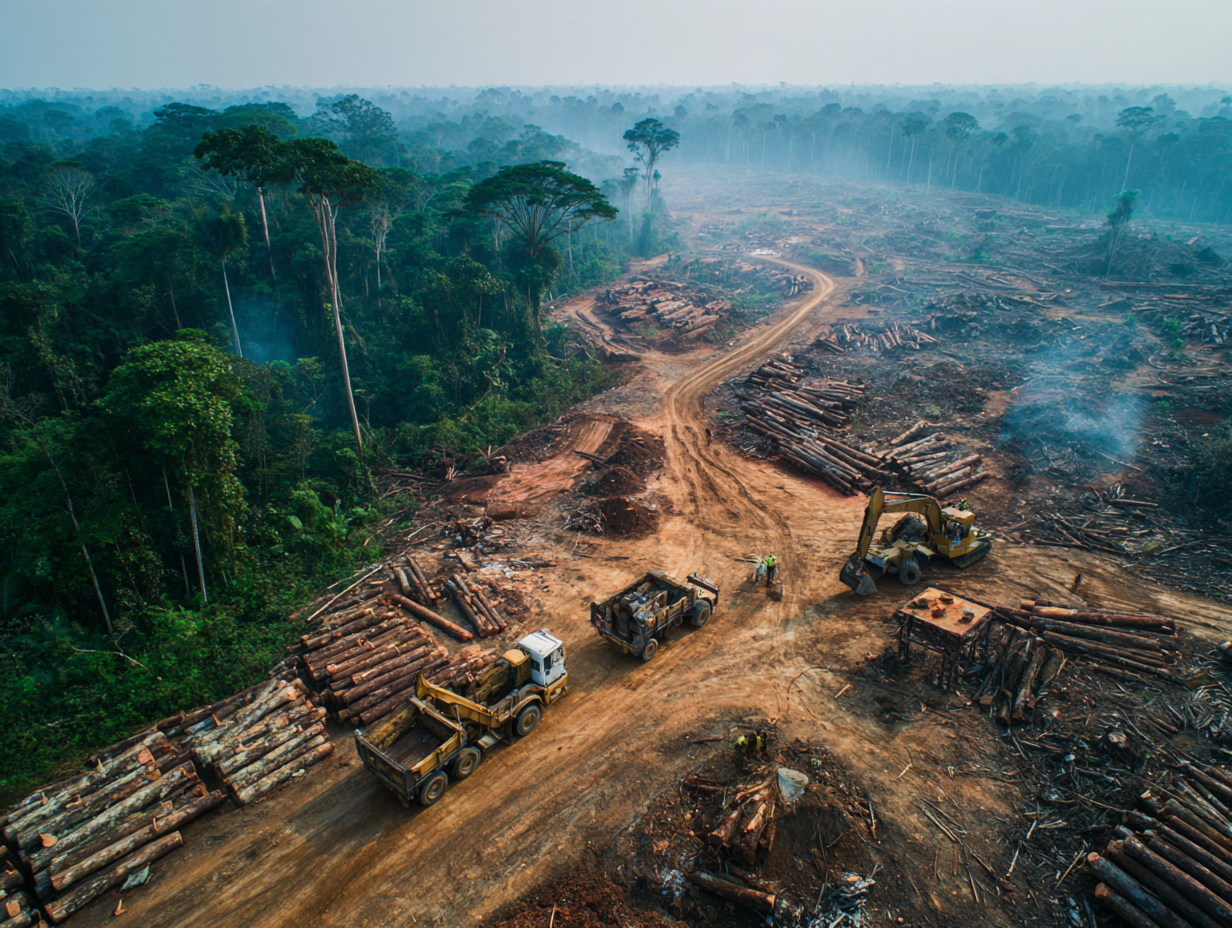
n the 1980s, modernity shattered violently into their world. This time it was guerrillas, adventurers, and armed criminal groups. Clashes turned their territory into a warzone. Their forest was sliced and cleared for coca plantations, cattle ranching, and illegal oil palm estates. What had endured for millennia collapsed in just a few years.
Entire communities were violently displaced and thrown into a world alien to them. Diseases decimated them, against which they had no defenses, and the loss of their territory destroyed the basis of their nomadic existence
The Extinguishing of a Cosmos
But the loss is not only physical. When a people who can distinguish over 300 edible plant species, who know the language of animals and the secrets of every root, are driven from their forest, it is more than a community that disappears. An entire cosmos of knowledge fades away: a living archive not stored in books, but in songs, stories, and embodied movements through the forest.
With every elder who dies without passing on their wisdom, a unique way of seeing the world vanishes — forever.
Why Their Story Concerns Us All
Today, the Nukak Makú are both: proof of the extraordinary diversity of human life, and a warning of the cost of our so-called development.
While we, in a state of total interconnection, lose our bond with nature, they embody a relationship with the rainforest that has grown over millennia. An organic coexistence with an extraordinary knowledge of plants, animals, and seasons.
Their story does not show how the progress of one society assimilates another; it shows the brutal collision of two worlds, in which one violently annihilates the other. Above all, however, it reminds us that ‘paradise’ is not lost because people live differently, but because one way of life eradicates another.
In Harmony with the Forest: The Culture and Way of Life of the Nukak
The daily life of the Nukak embodies efficiency and ancestral knowledge. This intimate knowledge of their environment is far more than practical skill. The ability to live with nature and understand it is rooted in a spiritual relationship with it, anchored in their complex cosmovision and a mythology rich in symbols. These permeate their everyday life and every aspect of their culture.
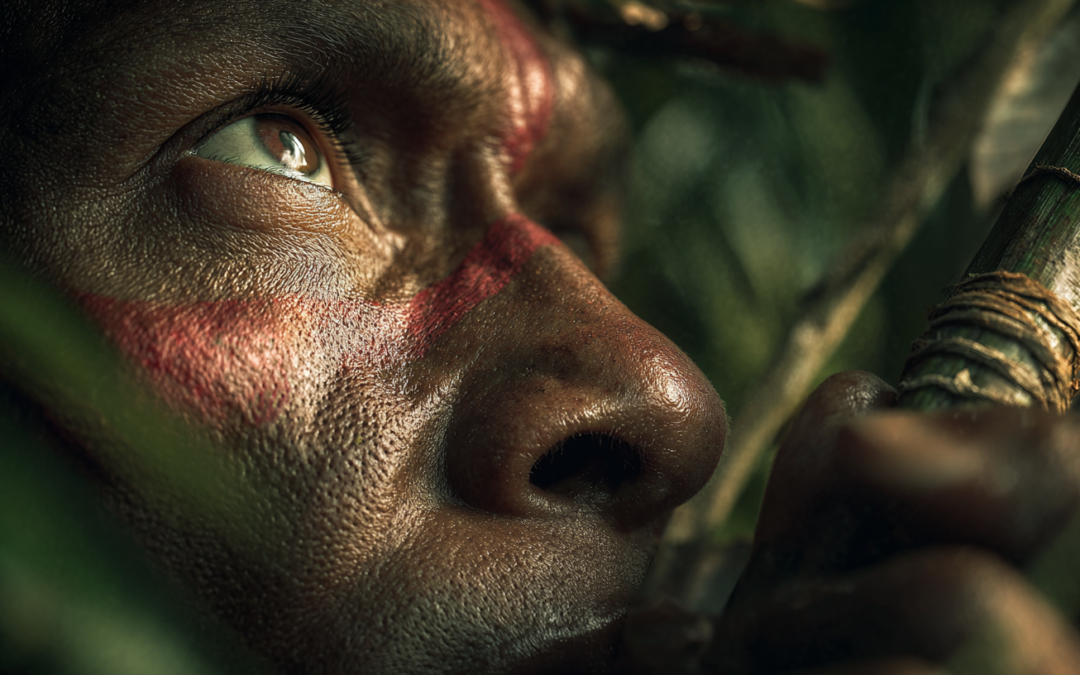
They navigate the rainforest with a precision that continually impresses ethnologists. They know an incredible variety of edible plants and root species, possess extensive knowledge of natural medicine, read animal tracks with astonishing accuracy, and know the migration patterns of the animals. Furthermore, they are highly skilled at hunting with curare darts from blowguns—a precise alchemy of five plants that paralyzes prey from 30 meters—and move through seemingly impenetrable thickets as if it were a familiar garden.
They also apply their profound knowledge of plants to fish hunting: They treat small side arms of rivers with stunning plant sap and thus catch for the community. In parallel, they deliberately cultivate palm forests of Buriti, Miriti, and Açaí, which provide fruits, fibers, and fermented drinks for future generations—an ancient form of a circular, sustainable economy.
Life in Motion
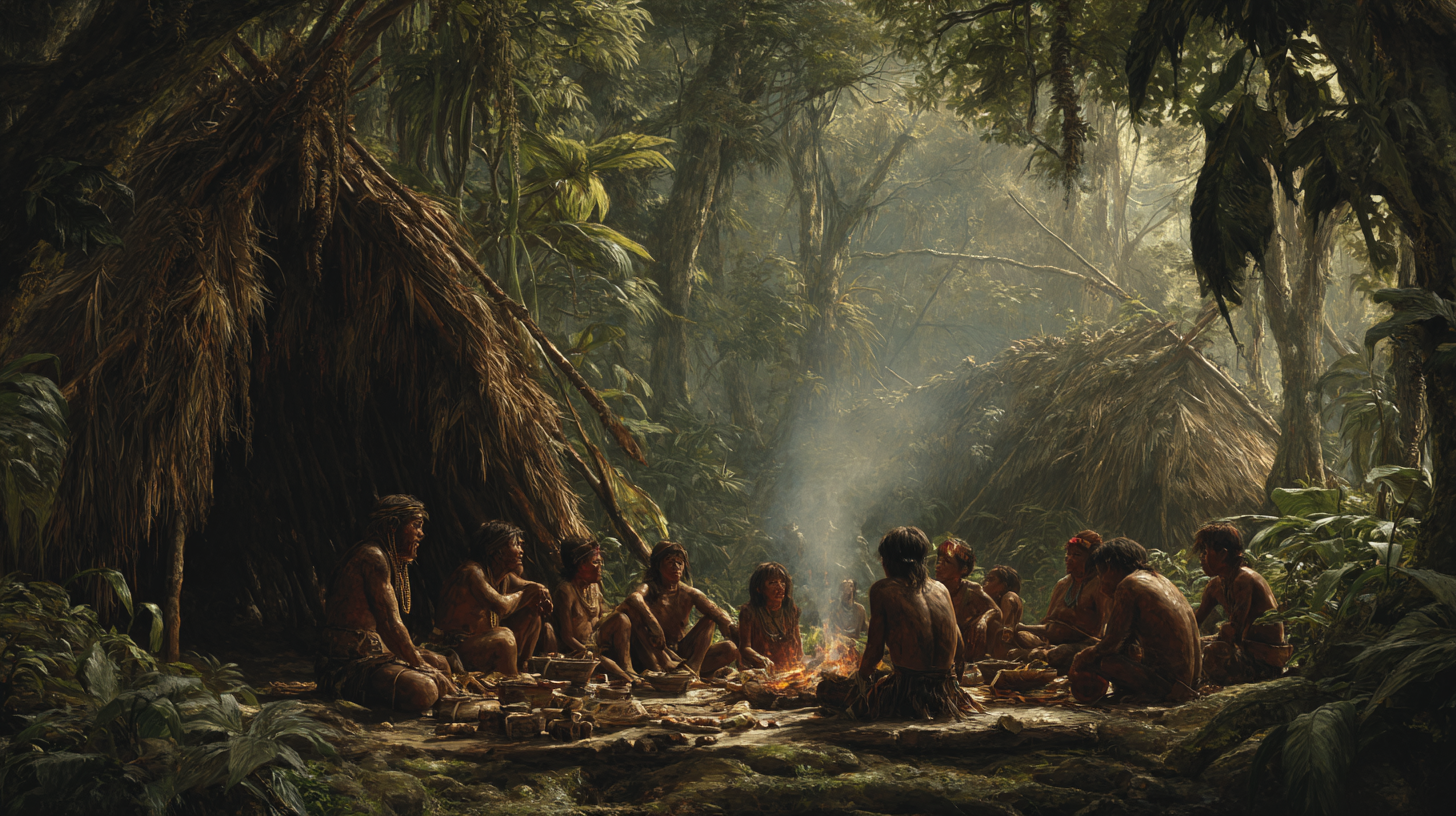
Their social life is organized in small, mobile family groups. Unlike many Amazonian peoples who settle along rivers, the Nukak deliberately choose the depths of the forest. There, in the heart of the rainforest, they find both their resources and their safety.
Their existence is characterized by constant movement. They rarely stay in one place for longer than three to five days. This extreme mobility is not restlessness but ecological wisdom.
By moving on before resources are exhausted, they maintain the forest’s equilibrium. The forest regenerates behind them; they leave behind hardly any traces. Their light palm-leaf huts, in which they live, are constructed in hours and disappear without a trace after only a few days.
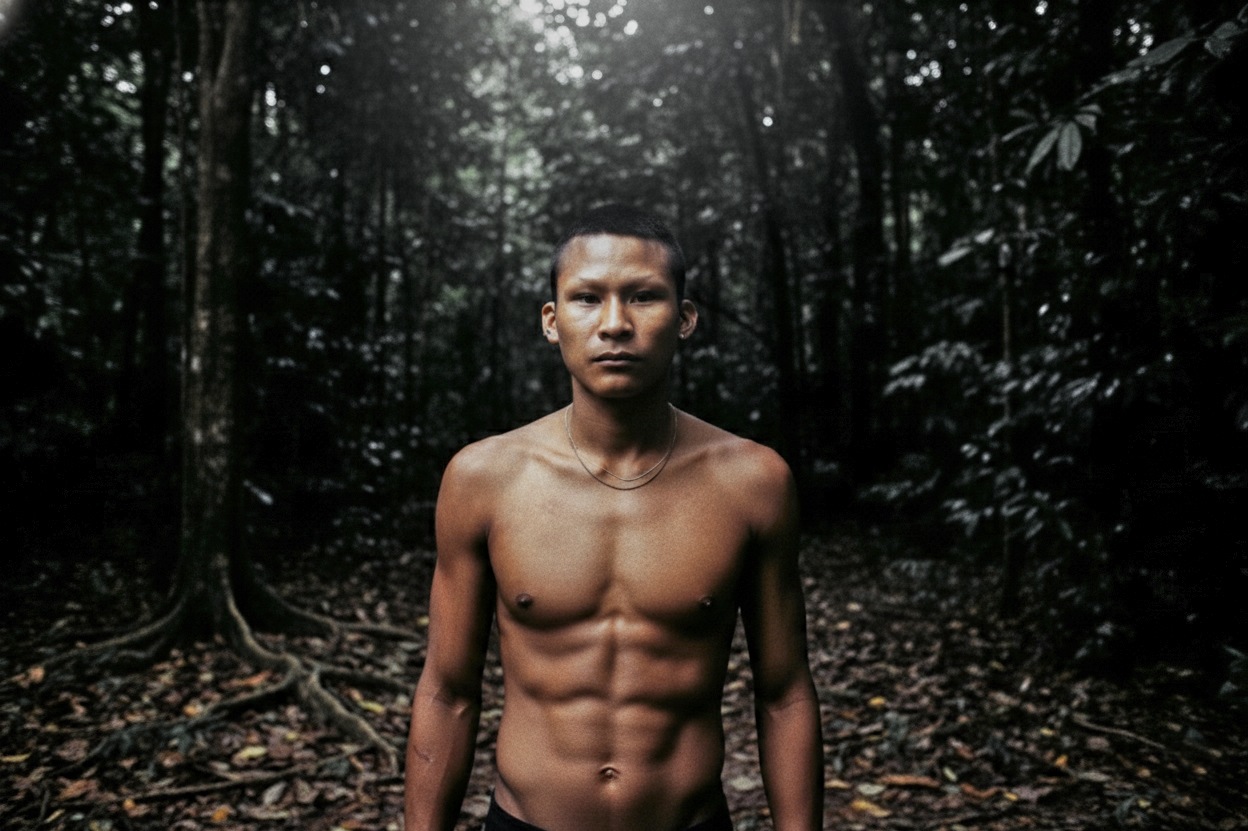
The Art of Owning Nothing
This way of life is a true mastery of mobility. Everything they own must be light enough to carry through the forest on their shoulders. Their entire household can be packed in minutes: the finely knotted fiber hammocks — their most important possessions — are rolled up; clay pots, tools, and a few other objects disappear into hand-woven baskets. Then, the group moves on.
What from the outside might appear as austerity is, in truth, the highest form of autonomy — for them, the very essence of freedom. No accumulation, no burden, no dependence on things. Their wealth lies not in what they carry, but in what they know.
Nomadic Hunters and Gatherers
Their diet is of remarkable variety: fish, game, turtles, dozens of fruit species, nuts, insect larvae, wild honey. A healthier or more ecologically sustainable diet is difficult to imagine — and yet this is only half the story of their deep relationship with the forest.
The Nukak are not merely users of the forest; they are its shapers. When they leave a campsite, they deliberately scatter seeds and organic matter, knowing these will grow into the fruit trees and useful plants they favor. When they return months or years later, they set up their camp beside these now-mature “forest gardens,” not on top of them — leaving the harvest intact for future visits.
This practice is far more than gathering. It is a form of sustainable forest management, perfected over millennia. The forest through which the Nukak move is not “untouched” — it is marked by generations of subtle human care. Their footsteps are seeds, and their camps, over time, become gardens of fruit.
A Nine-Thousand-Year-Old Tradition
The roots of this way of life reach far back into time. At the archaeological site of Peña Roja (“Red Rock Bluff”) on the Caquetá River, an Amazon tributary in Colombia, archaeologists found evidence of hunter-gatherer communities that lived there around 7000 BCE. The site lies near the present-day territory of the Makú peoples.
Alongside stone tools, researchers discovered thousands of palm seeds — burití, mirití, bacaba, açaí. These finds, more than 9,000 years old, reveal not only their use but their deliberate propagation and care. People systematically altered the composition of the forest. What we perceive today as a “natural” dominance of palm species is, in many cases, the result of ancient human design.
The continuity is astounding: the same techniques, the same ecological intelligence, the same mobility — sustained over nine millennia. The culture of the Nukak is not a primitive remnant, but a living testament to one of humanity’s most successful adaptations to the tropical rainforest.
While our agricultural systems in the Amazon exhaust the soil within decades and leave behind depleted landscapes, the Nukak have created a system that has regenerated the forest for millennia instead of destroying it.
The Myth of the Untouched Rainforest
The term “untouched rainforest” stems from a profound misunderstanding. The idea that the Amazon is an endless green wilderness waiting to be claimed is a myth. This view is not only false, but it also erases the true history of an entire continent.
The Amazon was never uninhabited. For thousands of years, it was a landscape shaped and tended by Indigenous cultures. Long before European colonization, organized societies flourished here — not destroying the forest, but transforming it into a productive homeland, with vast networks of settlements, earthworks, and an impressive knowledge of sustainable forest use.
Archaeological evidence speaks of this other world: geoglyphs, ruins of urban settlements, and Terra Preta soils, places that once sustained tens of thousands of people. The immense biocultural diversity of the Amazon — expressed in over 200 Indigenous languages — is not a backdrop; it is the driving force of the ecosystem itself.
The current diversity of cultivated plants is the direct inheritance of Indigenous forest management. To preserve the Amazon, we must protect its inhabitants — the communities that have lived here for countless generations as its true guardians and keepers. Their knowledge is our compass in the ecological crisis.
They are the ones who read and speak the language of the forest, co-creators of its past and the key to its future. They are the rainforest.
The Blessing of the Palm
For hunter-gatherer societies such as the ancestors of the Nukak, palms are not merely sources of food — they are complete systems of survival.
The majestic buriti palm is a mobile supply center: its fruits are rich in nutrients, its heart yields starch, its leaves serve for roofing, its fibrous sheaths become rope, and its cork-like husks make stoppers for drinking vessels. From its sap, a fermented beverage is prepared. Its light trunks are used as rafts. A single tree — dozens of uses.
The thorn-covered tucumã palm (Astrocaryum aculeatum) is even more extraordinary. Its entire trunk is armored with spines as sharp as porcupine quills — a perfect natural defense. Yet, in Indigenous knowledge systems, this is not an obstacle but a resource.
Its fibers are crafted into the strongest hammocks and ropes in the Amazon. The fearsome thorns themselves become nails, needles, and tools. The bright orange fruits serve as excellent fishing bait, and its wood is prized in construction. Even an “armed” tree is fully utilized.
Açaí, Sustainability, and the Ecological Knowledge of the Nukak
While the açaí palm (Euterpe precatoria) is celebrated today as a global “superfood,” it has been a fundamental part of life for Amazonian peoples for thousands of years. On Marajó Island and throughout the Amazon Basin, the clusters of small, dark-purple fruits are a daily staple. The thick, nutritious juice or pulp made from açaí — alongside manioc and fish — forms one of the essential pillars of regional sustenance.
Modern research now confirms what local communities have long known: açaí ranks among the most nutrient-rich natural foods on Earth, dense with antioxidants, essential fatty acids, and vitamins. What has always been daily nourishment here is elsewhere recognized as a nutritional marvel. For peoples such as the Nukak, however, the value of the açaí palm extends far beyond nutrition.
Their entire way of life embodies a practiced sustainability: a nomadic mode of existence, a precise understanding of ecological interdependence, and a minimal environmental footprint. This traditional ecological knowledge, refined over generations, shows how they do not simply use the forest — they shape and regenerate it, as seen in their careful cultivation and protection of palm groves.
From Paradise to Exile
The catastrophe began in the 1980s. Driven by skyrocketing world market prices for coca leaves, a wave of colonization swept across the northwestern frontier of Nukak territory. Thousands of settlers, speculators, and adventurers flooded the region. Organized crime took advantage of the absence of state authority: it moved in, ravaged the forest, and imposed its own law.
Indigenous communities were violently expelled from their lands — then forced to work as cheap labor on the very fields that had been stolen from them. For the Nukak, the violence escalated with the armed conflict between government forces and the FARC guerrilla. Their ancestral territory became a war zone — trapped in crossfire, struck from both sides. Survival in the forest became impossible; they fled into an alien world.
Today, the continued presence of criminal groups blocks any possibility of return. What was once a safe and abundant homeland has turned into a permanent zone of danger. Despite this existential threat, the Nukak struggle to preserve the legacy of their culture. They gather for rituals and ceremonies — acts of remembrance and resistance — to affirm their identity against disappearance.
Life in exile is marked by deprivation. Food scarcity has become chronic; the natural resources of their reduced territory no longer suffice. Forced labor on coca plantations, combined with diseases such as malaria, has exhausted the Nukak physically and spiritually, pushing them to the brink of collective collapse.
The Deadly Price of Contact
The first encounter with the modern world seemed, at first, harmless — almost an exchange marked by curiosity. In April 1987, a group of Nukak appeared in the farming village of Calamar. The news spread quickly and became a national sensation. But what began as a curious event marked the beginning of a tragedy. With the unstoppable expansion of settlers, further encounters became inevitable — and deadly.
The cost was devastating. The Nukak had no immunity to introduced diseases such as influenza and measles. Malaria, in particular, took countless lives; within a few years, their population had fallen by nearly half.
More than two decades after their displacement, many Nukak live in precarious conditions, dependent on sporadic emergency aid, marked by poverty and rootlessness. Their once rich and varied diet has given way to bitter scarcity. A single haunting image captures their situation: one chicken shared among twenty people.
In 2006, their leader Mao-be took his own life using the plant-based hunting poison of his people — a final, desperate act of despair. According to friends, he did so out of shame for being unable to protect his community from destruction.
Today, the Nukak live in makeshift settlements on the outskirts of towns such as San José del Guaviare, having fled the chaos that engulfed their homeland. Suspended in this forced limbo, with no certainty of return, they cling to their songs, rituals, and memories — a quiet, resilient struggle for cultural survival.
From Nomadic Life to the Refugee Camp
Thirty years after their official recognition by the Colombian state, the Nukak live in a fractured existence. Their transformation has been dramatic: only one small group, in the easternmost part of their original territory, continues to live a nomadic life. Most have been forced to settle, living in simple houses and cultivating small plots along the edges of colonized zones — areas now dominated by illegal coca production. Once hunters and gatherers, they have often become day laborers on these plantations; the art of hunting and gathering — once the foundation of their identity — is slowly disappearing.
Today, the Nukak rank among the most endangered Indigenous peoples in Colombia, alongside at least thirty-two other groups such as the Wachina and Wipiwi. A small glimmer of hope remains in their legally recognized territory, expanded in 1997 to over one million hectares under pressure from organizations such as ONIC and Survival International. Yet this protected area exists largely on paper; each day it is violated by settlers and armed groups.
The Dream of Return
Their deepest and most urgent struggle is for return — back to the remote forests where they once hunted and fished; back to those forest garden-like camps where they tended peach palms, chili peppers, yams, and sweet potatoes — living repositories of their ecological knowledge. In that world, there was no place for oil-palm monocultures, for cattle pastures, or for coca fields. Their loss is more than the disappearance of a homeland — it is the collapse of an entire ecological and cultural system built over millennia.
Their Fate, Our Legacy
The Nukak embody a relationship with the rainforest forged through millennia of lived experience. Their knowledge of sustainable resource use, forest regeneration, and ecological cycles is invaluable in an age of environmental crisis.
Their story reveals the devastating consequences of an economic model that places short-term profit above the long-term integrity of ecosystems and cultures. The Amazon stands under immense threat; ancient communities are being uprooted and pushed to the edge of extinction.
The crucial question is not whether we admire the Nukak, but whether we have the courage to protect the intricate web of life and knowledge that they represent.
For some, the forest is a living being, a breathing cosmos of spirituality and meaning.
For others, it is a mere commodity, a warehouse of timber, soy, oil, and gold.
Between these worlds gapes an abyss deeper than any conflict,
as fundamental as the divide between creation and annihilation,
as silent and ominous as the silence between a prayer and a death sentence.
