The Expansion of Being, Part IV
The early Modern Period
Prologue
The 17th century was an age of upheaval for Europe. Wars seemed to leave the continent scarcely any rest. In parts of the Holy Roman Empire, the combined forces of violence, plague, and hunger swept away nearly half the population.
With the colonization of the New World, the center of gravity of the European economy gradually shifted from the Mediterranean to the Atlantic. While Spain drew silver from the colonies, financial and trading centers emerged in Amsterdam and London, where new wealth accumulated and multiplied.
Despite the enormous influx of silver, Spain fell into increasing dependence and debt. It produced fewer and fewer goods of its own and covered much of its needs through imports. Silver from overseas flowed to foreign creditors, served to pay off debts, financed the court, and maintained armies. Thus the banking houses of the continent grew rich and influential; with their capital, trade, manufacturing, and shipbuilding flourished in Northern Europe.
At the end of this shift stood a new order. Europe’s economic and political dynamism shifted from south to north. The Netherlands and England became the centers of a global, capitalist-oriented modernity.
From Feudalism to Mercantilism
In the 17th century, mercantilism became the economic model for many European states. It rested on the notion that wealth could only be increased in limited measure and that state power could be enhanced primarily through the acquisition of precious metals, raw materials, and trading advantages. What one claimed for itself left less for others.
This logic promoted colonial expansion and trade wars. Wealth increasingly came to be seen as a prerequisite for political power and military dominance.
With the rise of the great trading companies, a new chapter in economic history began, and with it, a new form of global power. The English East India Company, founded in 1600, and the Dutch East India Company, founded in 1602, received trading privileges and monopoly rights across vast regions.
But they were far more than commercial enterprises. With their own armies and fleets, they combined economic, military, and political power in a form that was new for the time. Their organizational and governing models became influential templates for colonial expansion in the centuries that followed.
Their rise, along with the growing concentration of wealth in the hands of the few, accelerated the decay of older feudal structures. Step by step, they were replaced by an order increasingly oriented toward profit. While the Thirty Years’ War raged in Europe, the continent increasingly subjected itself to a different measure: that of capital.
European economy was still largely dependent on internal trade. Yet colonial luxury goods, spices, tea, and sugar became coveted status symbols. For a long time they remained the preserve of the nobility and the wealthiest elites. While there was a prosperous merchant class in 16th-century cities like Antwerp, Amsterdam, and Augsburg, the vast majority of the population hardly ever saw sugar, tea, or cloves.
The early Modern Period
The Reformation tore apart the unity of the Christian Church and called its dogmas into question.
The Church, which had been the guardian of truth for centuries, increasingly lost its unchallenged authority. Catholics and Protestants fought each other with a cruelty whose traces shape Europe to this day.
The Spanish Inquisition raged, the Thirty Years’ War ravaged, and in this torn Europe emerged the decisive works of early Enlightenment.
But it was not only faith that came under question. The worldview itself collapsed: Copernicus had shown in 1543 that the Earth was not at the center of the universe. Giordano Bruno was burned in 1600; his vision of an infinite universe seemed to many of his contemporaries an unbearable assault on the order of the world.
Tycho Brahe marked a crucial moment in the transition to a new understanding of the world. When he observed a “new star” in the sky in 1572, he did not trust inherited certainties but relied on precise measurements. This shook a fundamental assumption of his time: the heavens were no longer the perfect, unchanging realm as previously conceived.
Johannes Kepler advanced this transformation further. He described the motion of planets with hitherto unattained precision and showed that they followed not perfect circles but calculable orbits. Thus he corrected and deepened Copernicus’s heliocentric model and laid an important foundation for Isaac Newton’s later physics.
A Turning Point in Thought
The world was no longer understood simply as a divinely ordained order but increasingly as an observable, measurable reality whose laws were not determined by ecclesiastical authority.
More than scientific progress lay in this shift. While Europe began to measure the heavens, there simultaneously emerged the ambition to order the Earth as well. Observation became the foundation of knowledge, and science increasingly became the foundation of power.
Around 1580, Michel de Montaigne wrote in his essay “On Cannibals” that we only call barbarous what does not conform to our own customs. He confronted Europeans with the cruelty of their own wars and torture practices. The accusation of “cannibal” serves him above all to dehumanize the Other and justify violence. For Montaigne, the real horror lies not with indigenous peoples but in European practices of torture and extermination.
Galileo Galilei gave this new attitude its decisive scientific form. He claimed that the “book of nature” is written in the language of mathematics. Thus he made a radical distinction between the measurable properties of matter, such as size and weight and merely perceived qualities like color, taste, or smell. What cannot be calculated loses reality.
Nature loses its sensuality; it is increasingly less a “Thou” that speaks to us and increasingly a mute object that can be captured in formulas. With Galilei, a way of thinking crystallizes that had already announced itself before and would later be advanced by Descartes, Bacon, and Newton: the conviction that the world is most reliably knowable where it can be measured, calculated, and mathematically described.
In 1633, Galileo was condemned by the Inquisition for defending the Earth’s motion around the Sun. Only four years later, Descartes published his Discourse on Method. The world as one knew it was no longer secure.
Emancipation and Alienation
The Reformation stripped away much of the sacred from ritual practice and shifted part of religious experience into the conscience of the individual. Human beings gained personal responsibility and freedom of conscience; they were now permitted and required to read the Bible themselves and engage directly with their faith. Yet simultaneously, in parts of Reformation thought, the world lost its sacred permeation and became increasingly a stage for labor, duty, and obedience.
The Reformation was not the origin of this development, but it intensified a shift already underway: the spirit increasingly withdrew from the outer, sacrally interpreted world into the interior of the individual.
Calvinism made salvation a task of the individual. Work and success were regarded as proof of election; nature became an empty stage, and the individual exchanged the security of the Church for the lonely freedom of self-responsibility.
For centuries, Catholic faith had offered an unshakeable foundation: the world was divinely given, firmly structured, and comprehensible. The Church’s split through the Reformation and the devastating wars that followed destroyed this certainty. When the neighbor suddenly became an enemy heretic and Christians fought each other in the name of the same God, faith itself fell into crisis. The people experienced a spiritual disorientation previously unimaginable.
The Church’s authority was shaken, for it had proven incapable of making peace; on the contrary, it actively fueled war. The Pope called on Catholic princes to wage relentless combat against supposed heretics, while Protestant princes in turn understood themselves as chosen instruments of God. By claiming sole truth on both sides, they refused all compromise and drove the continent further into division.
What began as Luther’s criticism of the sale of indulgences and papal authority ended in a century-long catastrophe that devastated Europe.
The Witch Hunts
Contrary to a widespread assumption, the great European witch burnings were not a phenomenon of the “dark Middle Ages.” They reached their peak in the Early Modern period, particularly between the late 16th and mid-17th centuries. Tens of thousands of people were persecuted and executed as witches, most of them women.
The causes were manifold. Religious conflicts, demonological ideas, local power relations, social tensions, wars, hunger, and the increasing assertion of state and ecclesiastical authority all worked together. At the same time, forms of knowledge and ways of life came under pressure that could not easily submit to new orders. Knowledge passed down through generations about plants, healing methods, childbirth, and the human body rested in many cases on experience and direct observation.
Women played an important role in the transmission of this knowledge in many communities. In this epoch, the relationship between recognized and unrecognized knowledge changed. Medicine and natural science became increasingly institutionalized and professionalized. Knowledge was systematized and more firmly bound to institutions, while certain local and orally transmitted forms of experiential knowledge lost social authority.
European understanding of nature also transformed. Alongside older conceptions of a living nature, a mechanistic worldview gained significance. Nature could be measured, mathematically described, and regarded as an object of human knowledge.
The witch hunts were not merely an instrument of this transformation, yet they belong to the same contradictory epoch: Early Modernity did not emerge through a break with the old but through contradiction. Scientific knowledge and religious fanaticism, new freedoms and new forms of control, the expansion of knowledge and the exclusion of other forms of knowledge existed side by side.
In Heaven as on Earth
While telescopes measured the heavens and mathematicians captured nature in formulas, another no less consequential form of abstraction took place on Earth: real nature, human labor, and material goods were increasingly translated into monetary value, credit, and tradable capital.
One of the great ironies of this epoch lies in the fact that the New World was subdued under the pretext of Christian mission, in the name of the one true God. Yet in Europe, the adherents of this very God fought each other in bloody religious wars, financed with silver appropriated across the ocean under the same cross.
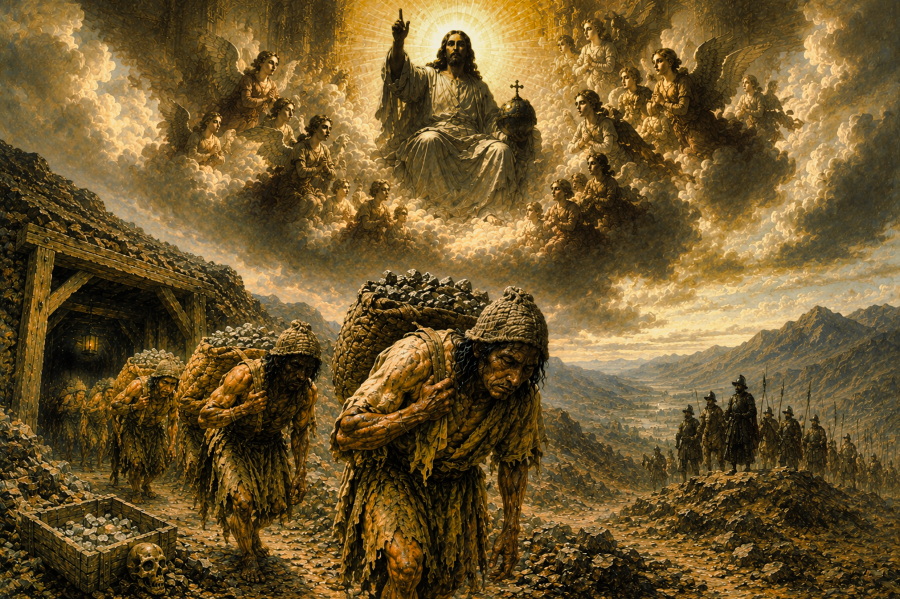
A vast source of this new wealth lay beyond the Atlantic. In the 1540s, immense deposits of silver were discovered in the mines of Zacatecas and Potosí and extracted on a scale previously scarcely known, under conditions of extreme exploitation and violence. The “rich mountain” became one of the most significant centers of colonial silver production and a nexus of an economy whose connections soon spanned large parts of the world.
At this time, confessional conflicts in Europe escalated dramatically. The discovery of American silver coincided with Luther’s Reformation of 1517, the split of the Church, and the beginning of the Habsburg Counter-Reformation.
The Habsburg emperors, above all Charles V and his son Philip II, understood themselves as the secular arm of the Catholic Church. They saw themselves called to combat Protestantism with all their might and pursue heretics with the sword.
The Royal Fifth
The Habsburg rulers, however, were chronically heavily indebted. Great banking houses such as the Fugger, the Welser, and Genoese merchant families had already loaned them enormous sums. Silver from overseas was therefore not merely plunder; it became the foundation of their creditworthiness.
The Spanish Crown claimed, in return for the right to conduct missionary work—the so-called Patronato Real—one-fifth of all precious metal discoveries: the Quinto Real. This royal fifth flowed directly into the coffers of mercenary captains, into the arsenals of Milan and Naples, and into the war fleets deployed against the Protestant powers.
The Protestant princes in the Empire who opposed the Emperor thus fought not only a religious adversary but a power whose mercenaries and cannonballs were financed with Peruvian silver.
The Lifeblood of Power
The silver fleets that docked annually in Cádiz became the lifeblood of Habsburg politics in the 16th century. Without the yields from Potosí, Philip II’s policies in this form would scarcely have been conceivable. And without these resources, the Eighty Years’ War would have taken a different course.
The emergence of an independent Holland, which shortly thereafter itself rose as a colonial power and reordered the competition for global dominance, was bound up with it. The history of Reformation and Counter-Reformation is therefore not merely a history of theology and the printing press. It is equally the history of a worldwide plundering operation whose yields first made conflicts of this magnitude possible.
Colonial silver provided the financial fuel for the Thirty Years’ War, which largely devastated the European continent. The New World served the Church not only as a means of soul-gathering but also as a source of money. Mission and war chest were two sides of the same coin.
For God and Gold
The wealth extracted in the Andes and Mexico did not merely transform warfare; it transformed the entire European economy. The quantities of silver and gold that Spain received from America in the 17th century are very well documented.
n normal years, two great fleets left America: one from Veracruz in Mexico, one from Portobelo in Panama. Each consisted of 15 to 30 ships, which over a century amounts to nearly 5,000 transatlantic passages when accounting for losses due to war, piracy, and storms.
Silver and gold bars as well as coins typically made up 100 to 200 tons of cargo weight per ship, securely stowed in the lowest hold of the galleons. When a fleet entered the harbor of Seville, it moved in one stroke an enormous load of colonial goods and precious metals to Europe.
Between 1500 and 1800, Spanish American mines, most notably Potosí in present day Bolivia and Zacatecas in Mexico, produced an estimated 150,000 to 170,000 metric tons of silver, with the vast majority, roughly 70 to 80 percent, originating from Potosí. The gold extracted during this period is estimated at over 1,000 metric tons.
These figures reflect official registries along with realistic historical estimates. They do not account for the massive scale of smuggling, corruption, or the undocumented melting down of gold and silver artifacts, meaning the actual production was undoubtedly higher.
When one has seen the Almacenes, the imposing vault chambers in the fortress Real Felipe in Callao, one grasps the dimensions of this gigantic operation: echoing rooms of immense size, built for the sole purpose of stacking the silver and gold of the Andes before it was shipped to Europe with the Atlantic fleet.
Silver and Debt
The silver flood caused prices in Europe to rise sharply between 1540 and 1640, particularly for staple foods. This burdened the urban lower classes and also placed pressure on the rural population. For Spain itself, overseas wealth proved more burdensome than sustainable, as the purchasing power of silver declined with inflation. Despite the inflows, the Spanish Crown had to declare state bankruptcy multiple times in the 17th century: in 1607, 1627, 1647, and 1662.
Moreover, a large portion of the silver did not remain in the country. It flowed from the Crown directly to German and Genoese banking houses that financed the wars, as well as to foreign suppliers of the armies. Thus, for example, around 1590, of 11 million pesos that arrived, approximately 6 million flowed directly to Italy to cover military expenses and imports.
The Pretext of Mission
The Spanish Crown justified its conquests with the mandate to spread the Christian faith. The conversion of the indigenous population became the moral legitimation for colonization. Yet behind this claim stood concrete economic and political interests.
The Church’s theological acrobatics provided the intellectual superstructure for colonial expansion. The indigenous peoples were portrayed as heathens, as immature or God-forsaken, as people in need of salvation through Europeans. This argument transformed conquest into a duty, subjugation into an act of mercy.
The very same silver that carried and legitimated the mission overseas financed wars in Europe, even against other Christian powers. A defining characteristic of this epoch lies in the fact that Christian charity was often factually limited to one’s own confession, while the resources of the New World were used to settle religious and political conflicts in Europe itself. Whoever controlled the treasuries controlled the weapons; whoever controlled the artillery could claim to act in God’s name.
The revolts, iconoclasms, and sieges in Europe were not solely wars of faith. They were also nourished by resources violently extracted overseas. What appeared as a religious war was simultaneously a struggle for power and wealth, fueled by colonial silver and paid for with indigenous blood.
Contradiction and Certainty
While these conflicts were being waged, the societies of the New World were subjected to massive violence: oppression, forced labor, and introduced diseases led to the decimation or destruction of entire populations and the disintegration of social structures.
In this, a fundamental contradiction of the epoch becomes starkly apparent: a religious claim that asserted universal validity was in practice enforced by means that clearly contradicted it.
Bartolomé de Las Casas
As a participant in the conquest of Cuba, he was himself a conquistador and owned an encomienda—a piece of land along with the indigenous population living on it, who were obligated to forced labor. His turning point began in 1511, when the Dominican Antonio de Montesinos delivered a famous sermon accusing the colonizers and refusing them confession. Thereupon Las Casas returned his lands and the Indians assigned to him and began dedicating his life to fighting for their rights.
In his writings, especially in the Brief Account of the Destruction of the Indies, he denounced the cruelties of the conquistadors, which he had witnessed as an eyewitness.
He wrote already in 1552 in his report:
“The Christians began by seizing the Indians’ wives and children, making use of them and mistreating them. … They swept through the lands, sparing neither child nor elder, neither pregnant woman nor new mother, ripping open bodies and hacking all to pieces…”
And on the cruel executions, he writes:
“They built great gallows, constructed in such a way that the feet of the victims barely touched the ground, and on which they could hang thirteen of them at a time, and beneath them they placed wood and set it alight to burn them alive, in honor and adoration of our Savior and the twelve Apostles.”
(Relación de la destrucción de las Indias, Sevilla 1552)
All the Peoples of the World Are Human
With this sentence, Bartolomé de Las Casas in the 16th century challenged a conviction that served the conquerors as moral justification. His words were directed not only against the violence of the conquistadors but also against the notion that the value of a human being depended on origin, religion, or culture. For his time, this marks an early and remarkably clear form of argumentation for universal human dignity.
Yet colonial expansion continued. Mission, commercial interests, and military violence were closely linked.
The Illusion of World Domination
This massive silver flood left its traces not only on the battlefields but also shaped the face of the continent. The Baroque age transformed the accumulated wealth into an unprecedented backdrop of gold, stone, and illusion.
The vast palace complexes of absolutist rulers and the exuberantly ornamented cathedrals of the Counter-Reformation served as propaganda turned to stone. They were meant not only to impress subjects but, through splendor and overwhelming display, to make the order of things appear natural and divinely willed.
The Baroque deployed an abundance of precious materials: marble, gold, noble woods, and rare pigments. The opulent altars in Seville, Rome, or Vienna were not innocent testimonies to piety but gleaming trophies of a world order that transformed colonial violence and internal impoverishment into the architecture of power. The suffering of the Indians in America and the poverty of one’s own rural population were cast in gold to stage the absolute power of Church and Crown as inviolable.
The Shattered Dream
Thus, at the end of the 17th century, Europe stood in a landscape of rubble of its own making, paid for with the suffering of indigenous peoples and the misery of its own population.
The silver from America had vanished, the coffers of the Spanish Crown emptied. While finance and commerce grew richer, wealth drained away into wars, extravagance, and the dream of world domination.
Cities lay in ruins and ashes in many places, fields were devastated, populations decimated. One’s own faith was called into question, and trust in the Church was deeply shaken.
While the nobility in Madrid and Versailles celebrated festivals and intellectuals debated human rights, peasants starved in the countryside, and monarchs prepared for the next wars.
The Loss of Old Certainties
As old certainties crumbled, new orders emerged that linked knowledge, power, and economic interests in previously unimagined ways.
The colonization of the New World and knowledge of the existence of previously unknown civilizations struck like a shock to European self-understanding. Suddenly there were entire continents filled with people never mentioned in the Bible.
This encounter with the foreign forced Europeans to the realization that their world was only part of a much larger whole. On one hand, this nourished a dangerous civilizational arrogance; on the other, the thought first germinated that one’s own way of life was not the only conceivable one.
The Spirit of Capital
The rise of trading companies and the commercialization of the economy fundamentally changed the thinking of urban elites. Labor and nature were increasingly viewed through the lens of utility and domination. Members of the rising upper class defined their social worth no longer solely through inherited status, but increasingly through economic success.
After 1648, a new worldview had progressively established itself in the centers of science, politics, and commerce. Raw materials and the peoples living in the colonies were increasingly regarded as available resources. At the same time, merchants and states developed methods to enforce control and oppression systematically and with growing severity.
This approach generated not only enormous power and profits, but also created the structural conditions for further economic exploitation and political domination.
For something decisive had been learned in the colonies: how to systematically subjugate people. Expropriation, the fragmentation of labor, and rigid hierarchies formed a system that left little room for self-determination. Therein lay its very effectiveness.
After 1700, these same techniques were systematically reimported into Europe. The privatization of common lands in England and continental Europe destroyed communal economies; millions were uprooted. Factories arose not as technical necessities but as instruments of control modeled on colonial practice. The European worker became the new subject of colonial exploitation, only this time on their own soil.
What began as dominion over distant territories returned to Europe as a principle of social control. The irony: in the effort to subjugate the world, Europe colonized itself.
Early Globalization
The history of the East India Company demonstrates that the emergence of the modern world economy was no neutral success story. It rested in large measure on coercion, extreme inequality, and ruthless power politics.
The silver mines of Potosí and Zacatecas supplied the precious metal with which Europe financed its trade with Asia. Without silver from the New World, the East India Company could scarcely have realized its expansion into India and China to this extent. American silver became one of the fuels of the first global trading empire.
This American silver was exchanged in India for cotton cloth and other goods, later in China for tea and porcelain. These commodities subsequently reached Europe and the North American colonies. Thus a far-flung commercial circuit linked America, Europe, and Asia permanently together for the first time.
Not everything later framed as natural development was progress for all; in most cases, it meant progress for some, and for many, it meant expropriation, displacement, and the systematic denial of self-determination.
The Enlightenment
In the late 17th century, ideas began to take shape in the universities and scholarly circles of northwestern Europe that would give rise to the Enlightenment in the century to follow.
A new self-understanding of humanity emerged. No longer revelation and authority, but reason itself should henceforth be the measure of thought and action. Man could, according to the conviction of the enlightened, comprehend and shape the world by his own force, provided he liberated himself from prejudice and ecclesiastical tutelage.
These ideas, however, were not common heritage but the privilege of a tiny minority. The Enlightenment provided not only the ideals of freedom and equality, but also the categories by which peoples were classified as “civilized” and “uncivilized,” and it granted oppression an apparently rational and scientific legitimation.
They reached only a minuscule fraction of the population: educated citizens, reform-minded nobles, wealthy merchants, and a few clergy. The vast majority—peasants, day laborers, artisans, and women—had no access to the writings of philosophers nor the leisure to reflect upon reason and human rights. For them the world remained as it was: marked by hard labor, ecclesiastical authority, and the immovable hierarchies of estate and gender.
The universalist claim of the Enlightenment was from the outset greater than its social reach. And yet it deployed an explosive force that would challenge the existing order. Reason became a weapon against the dogmas of the Church and the old order, but at first only in the hands of those who already possessed power and education.
It was an elite project that only later, through circuitous paths, reached the broad population. And it remained, even then, forever an unfinished project.
Read in Part V
Into this landscape torn open by rupture
stepped a man who would provide
the philosophical foundation for a new order:
René Descartes. His goal was absolute certainty.
But the price would be high.
