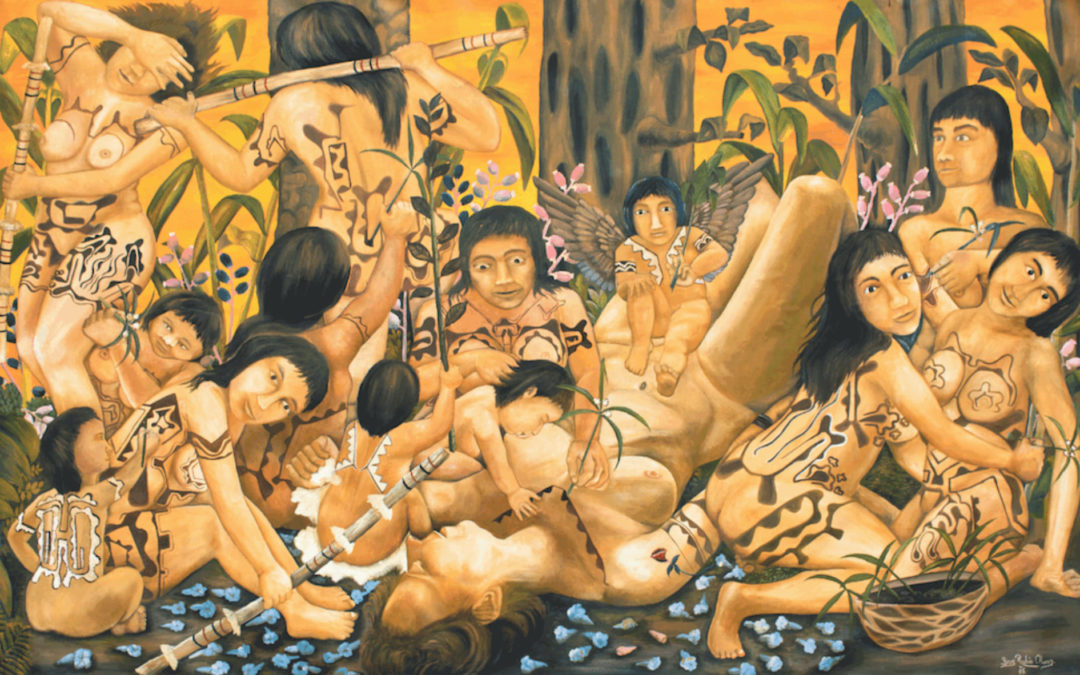
Brus Rubio, mujeres pintadas de rana.
Human forms of symbolic expression and visual traditions in the Amazon reach back many millennia. Brus Rubio depicts a quiet, almost reverent moment of preparation for a ceremony. A group of women, together with their children, paint their bodies with signs and symbols. On such ritual occasions, traditions are passed from one generation to the next through observation, experience, and participation.
Contemporary Art of the Amazon
Contemporary art from the Amazon goes beyond the aesthetic. As a living expression of Indigenous worldview and spiritual interconnectedness, it locates the human being within the cosmos of the rainforest. It embodies the ongoing dialogue between culture and cosmos, between humanity and the immeasurable world of the Amazon.
Culture and Identity of the Amazon
The paintings of the Indigenous peoples of the Amazon are far more than works of art — they are living chronicles. Their powerful, symbol-laden visual language opens a window onto a world of spiritual beings and conveys a unique understanding of the cosmos and human existence. They reveal how ancestral knowledge and spiritual depth form the foundation of an identity that understands the human being as an integral part of nature.
Craft as Spiritual Practice
This vision takes material form in craft traditions: archaic patterns on ceramics, radiant feathers on ceremonial masks. These are never mere ornaments but portals into a world where the physical and the spiritual intertwine. Masks, body adornments, and garments thus serve as essential media in rituals and ceremonies. They are tools for communicating with the spiritual world, invoking powers, and safeguarding the well-being of the community.
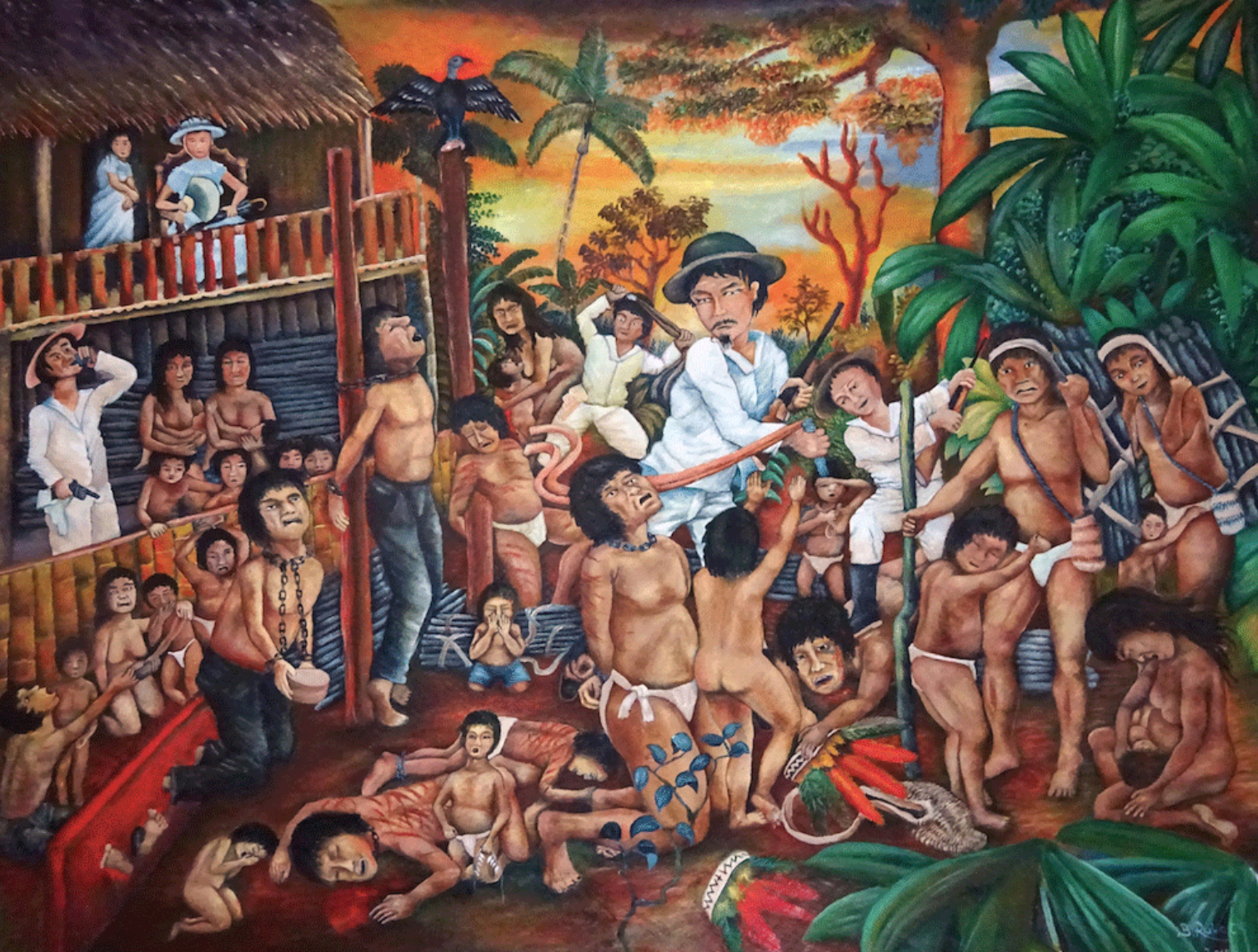
Brus Rubio does not tell history as a chronological sequence of events. In this work, he brings different experiences of colonization into a single pictorial space: mission and violence, disease and subjugation. Past and present converge, revealing how history remains alive in collective memory.
Memory and Historical Responsibility
Yet this art preserves not only living culture, but also its collective memory. It stands as a testament to historical injustice. During the rubber boom, Indigenous peoples endured profound trauma, a truth that has often been deliberately silenced. Today, Indigenous artists confront this legacy in their work, ensuring that these memories are not forgotten.
In doing so, they create a form of counter-memory. History is no longer told solely from the perspective of those who had the power to write it, but also through the experiences of those who suffered its consequences. Indigenous art gives a place to people, experiences, and memories that were long pushed to the margins of official narratives.
I myself have felt the weight of that past. At night, sitting by the fire, I listened to elders recount the horrors their ancestors endured. The trauma still echoes through the communities, a persistent reminder of wounds that reach across generations. Within this art lie both dimensions: the source of spiritual identity and the incorruptible archive of collective pain. It offers us a way to approach the peoples of the Amazon, their histories, and the complexity of their worlds.
The Aesthetics of Emancipation in the Amazon
In recent years, art from the Amazon has gained significant prominence in the cultural scene by challenging traditional notions and amplifying the voices of Indigenous leaders in the region. Today, it stands as an influential platform in the struggle for Indigenous rights and the protection of ancestral territories.
This artistic practice radically questions conventional ideas of art and grants Indigenous perspectives substantial weight. It initiates an ongoing redefinition of cultural symbols — a process that the communities themselves guide, actively reinterpreting their signs and asserting their meanings with sovereignty.
From Ethnographic Object to Political Agent
The role of the artist has also changed. Once categorized as representatives of folkloric traditions, they now demand wider recognition and assume full agency over how their works are classified and disseminated. This shift in consciousness has profoundly altered perception: Amazonian art is no longer seen as mere ethnographic heritage but is recognized as a living archive and a powerful form of political expression.
This development finds its most visible and concentrated form in large-scale murals. These have become unmistakable platforms of environmental activism. Here, Indigenous artists transform walls into public manifestos, their visual language draws attention to the destruction of the rainforest and the threat to its communities, calling unequivocally for the protection of the land and for sustainable ways of living.
The Voice of the Rainforest
Amazonian art does not accuse, it offers hope. Through their powerful paintings and passionate commitment, artists call upon the world to recognize the inalienable value of the rainforest and its inhabitants. Their works become the voice of the forest, urging us to become responsible stewards of this irreplaceable ecosystem.
A Universal Language Beyond Words
In a world shaped by cultural diversity and the fragility of our planet, Amazonian art opens a space of connection — a universal language beyond words, transcending borders. Whether in the ancestral patterns of the Shipibo-Konibo, the mythical aesthetics of the Huitoto, or the spiritual representations of many other peoples, its symbolism fosters understanding and respect across continents. As we explore the stories contained within these works, we begin to recognize the diverse worldviews they embody — and the profound interconnectedness of all life that lies at their core.
From Empathy to Action
This awareness awakens empathy and inspires action. In this way, art itself becomes an appeal to acknowledge the threats facing the Amazon and to assume our shared responsibility for its protection. In my work with artists from the Amazon region, I have often witnessed how their creations move and transform those who encounter them. When we find ourselves reflected in their vibrant images, a vision becomes tangible — a future in which humanity and nature do not exist apart, but thrive together as one.
Overcoming Separation: Art as a Mirror of Connection
Amazonian art is the fertile ground in which we plant the seed of our gaze. Only when we step into the furrows of that soil — into its light and its shadow — does true reflection begin to take root. This encounter allows us not merely to look at the worldview embodied in that art, but to enter into it and truly understand it.
Ultimately, this engagement leads to a profound realization: the appreciation of the fundamental interconnectedness of all life — a unity that this art does not simply depict but expresses in its very essence. It ceases to be an object and becomes an experience — an encounter.
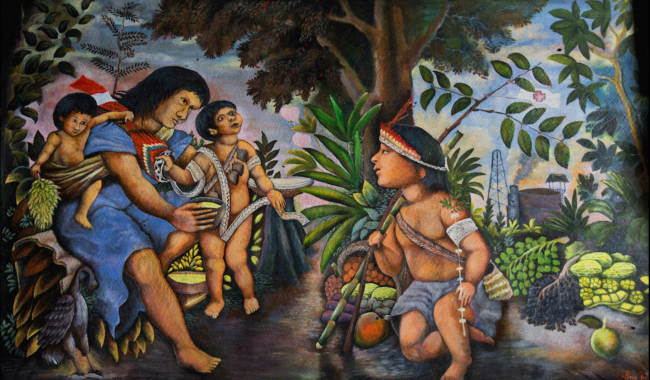
Indigenous Thought: The Unity of All Life
This deeper insight goes beyond understanding. It dissolves the supposed separation between observer and observed, between human culture and the natural ecosystem, revealing it as an illusion. Reflected through this art, we no longer see ourselves as external spectators but as integral parts of the universe it portrays.
In this light, our perception of the ecological crisis transforms: it is no longer experienced as an abstract threat to a distant “other,” but as a fundamental disruption within the web of relationships to which we ourselves inseparably belong. Art thus lays the ethical foundation for action rooted in connection rather than obligation, and imagines the vision of a future symbiosis.
Inspiration for Harmonious Coexistence
Art from the Amazon is far more than visual expression. It brings together memory, identity, experience, and different ways of understanding the relationship between human beings and their environment.
These works emerge from a region of extraordinary cultural and biological diversity, yet one that is also deeply threatened. They bring us closer to realities and forms of knowledge that for a long time were ignored, displaced, or viewed from an outside perspective.
Perhaps one of the most important contributions of this art lies precisely here: it invites us to look again. Not only at the Amazon, but also at our own relationship with nature and at other ways of understanding the world.
Discover contemporary works from the Amazon in our collection and become part of this movement for cultural appreciation and ecological responsibility.
